Showing posts with label tv-cooks. Show all posts

Sunday, 19 September 2010

Restaurant Sat Bains

Nottingham's only Michelin starred restaurant, Sat is also a molecular chef, so some comparisons with the Fat Duck are inevitable, so I'll deal with the 2 biggies straight off. Sat's menu is a lot more local & seasonal, he also is a bit less multi-sensory/theatrical than Heston. We'd got a package offer, so a
room, champagne on arrival and the 7 course tasting menu. The wine list is huge and roams from pretty reasonable (25-30) to stratospheric. Having had the paired wines at the Fat Duck we did the same here. First up was an amuse bouche from the kitchen of an oyster foam with a pigs head croquette and a smoked haddock one, both were really good. Next was Sat's signature dish of ham, egg & peas. If you don't know this is the only dish that scored a perfect 30 in the great British menu and consists of a slow poached duck egg, peas, pea & mint sorbet and pata negra ham. I've eaten a fair few poached duck eggs, this was glorious. The sorbet tastes incredibly fresh & green and provides a great contrast to the warm duck egg.
Then it was onto the menu proper and an Alsatian white that we ended up killing, that was for the starters and went incredibly with the first, Pork, pears, chicory & monkfish which came with a liquorice sauce. The pork was superbly cooked and the pears which ranged from raw to a pear gel really went with it, the monkfish & liquorice were good together, but might not have needed to be on the same plate as the pork. Next up was Organic salmon with coriander.This was a cube of raw salmon, incredible pickled vegetables where placed on top and covered in an oyster & coriander emulsion. Brilliant, absolutely brilliant. 
Next came NG7 2AS, an enigmatically named dish, that turns out to be foraged from with in a mile of the kitchen. If you get to eat it, it probably won't be the same as this. A salad of mainly sorrels with pickled elderberries, textures of crab apple, hazelnuts and a hazelnut  sand. With a glorious horseradish croquette.


For me this was the stand out dish, and it took a while to eat as everything needed to eaten on its own and then in combination.
The "main course" turned up, Yorkshire grouse with blackberries and a home made faggot, paired with a premier cru Burgundy. If the dish was any bigger then it would have been instant gout. Lovely meaty flavours from the (very) rare grouse breast and the beef faggot, complemented incredibly by the deep blackberry sauce and matched to the kind of wine that makes you understand where Jilly Goulden & co are coming from.
Then came "Crossover" a bridge between the main course & dessert. Its a mix of ham, pineapple, maple syrup and Parmesan cheese. Sounds odd but really works. 
The first of the desserts was simply titled "Chocolate" and was a rich chocolate mousse with a thyme & salt caramel and a buttermilk ice cream paired with an Australian muscadet, another standout bit of wine matching. Again well chosen complementary flavours the acidity of the buttermilk cutting through the rich sweetness on the plate, the addition of thyme to caramel provided a pleasant je ne sais quois and is something I think I might give a bit of a try in future.
The final menu course was "Raspberry" which consisted of a dish containing various raspberry things (a granita, a gel, whole berries) dotted with hazelnut meringues, both hard and soft and a lolly of freeze dried raspberries a white chocolate shell and a beetroot ice cream. 


Beetroot is much loved by the modern/molecular chef as it has a very interesting trick, where its flavour can be flipped between sweet & savoury depending on what it's served with(*). If you know that you can play with it in this dessert. This was teamed with a Sauternes which was probably the most disappointing wine of the night, in so much as it was merely very good, compared with the excellents of the other wines. Finally the richest chocolate brownie I've ever eaten arrived on a small square slate. I managed half of it.
So go, it's highly recommended, staying over in one of the fairly luxurious rooms takes a bit of a sting out of the bill, but you are paying toward the top end of 1 star prices. That said I don't think it can be too long before a second star arrives. The dishes are innovative and very well made, the wines well chosen and the service spot on. There is a 12.5% service charge on the food bill, which is  reasonable at this level.

(*) A high degree of acidity flips the beetroot from beetrooty to blackcurranty. Eating the raspberry chocolate shell to expose the ice cream with in (as shown in the photo) allows you to taste the beetroot ice cream in its vegetable guise. Dipping it into the granita turns it fruity again. 

Wednesday, 28 April 2010

Fabulous feasts

I think its fairly obvious I'm a fan of Heston Blumenthal, so I'm an avid watcher of his TV shows. Here in the UK Channel 4 are well into the second season of fantastic feasts. The first series was responsible for my wallet damaging trip to Bray, to experience the Fat Duck for myself (nutshell, its worth it). This time round I've noticed more about how he reuses and revisits ideas & techniques.

Last weeks camel burgers are a straight remake of the perfection burger with camel instead of beef, served with the famous triple cooked chips (which once I get a digital sugar thermometer I'll be making). Last night he used the blood/black pudding recipe from "Balotine of Anjou Pigeon" in several places.The butter salted caramel from millionaires shortbread, also saw some use (in the fabulous graveyard dessert). I'd decided that I was going to use that if/when I next needed a caramel myself (of course I'll need the thermometer).

Anyway having made another batch of the burgers (the farm shop had some beef on offer & it seemed to make sense) ready for the BBQ I'm unlikely to use a different burger recipe as the results are so good, just goes to show how what initially seemed to be cutting edge & outre techniques are a lot more reusable than they first appear.

Monday, 8 March 2010

Roast Dinner

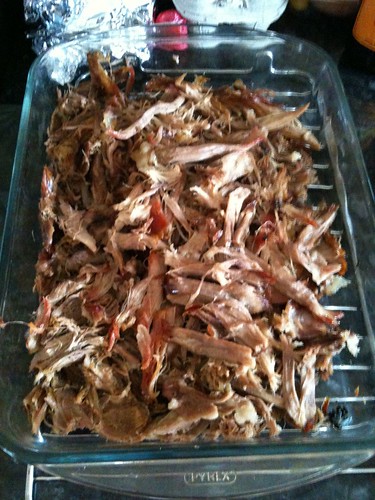
Remember that lamb shoulder ?

Here it is ready to go into the oven having been studded with garlic & herbs. For shoulder I use Jamie Oliver's slow roasted lamb recipe. I ignore the vegetables, preferring to go with a more standard roast potatoes and 2 veg serving style.

If you can get yourself a full shoulder this is one of the nicer things you can do with it. Season and herb stud the lamb and then slide it into the oven, it's going to be in there for 3-4 hours. you can leave it alone and just enjoy your kitchen warming up and being scented with roasting herbs & meat.

Its a very lazy way to make an impressive roast dinner, there are maybe 10 minutes of prep work required and then you've a couple of hours in which to do what ever you fancy before heading back to the kitchen to sort out veggies, mint sauce and any other bits of  dinner that you want.

The lamb comes out of the oven tender and juicy. Shoulder is horribly difficult to carve, so don't bother, shred it.

A full shoulder will comfortably feed 8 but don't plan on left overs (even though cold it makes a very good lunch) as somehow there never seems to be any.

Monday, 22 February 2010

Dinner party

Well it all almost went to pieces due to a surprise snowfall.

Let me explain. I meant to go & get the meat for the main course on Saturday, unfortunately things conspired to get in my way. No problem, the farm shop is open 10-4 on a Sunday, the only thing I need is the Beef (vital, after all the centre piece is a Beef Wellington). I have several recipes for Beef Wellington, the traditional ones require gallons of claret and heaps of Foie-gras. The more modern ones use a mushroom Duxelles. I prepared that & the puff pastry on the Saturday, thinking Sunday would be a quick dash out to get the beef, some work with our friends & then assemble & go.

Fortunately the snow didn't bring everything to a grinding halt & I was able to get out to the farm and get my fillet. The beef I buy is traceable from birth local meat (the cows are usually in the field opposite the shop) that is properly aged. I'm happy to eat this beef raw (and have in the form of carpaccio). However it made a 40 minute errand into a two hour expedition. Needless to say no work got done & I spent time in the Kitchen instead. The pastry was already made as was the duxelles, so the first job was to whip up some square pancakes. In a modern beef Wellington these stop the pastry going soggy by acting as a barrier to the beef juices. Traditionally you used short crust as the bottom pastry & puff on top. Once done (and there is something very odd about square pancakes) they get set aside to cool.

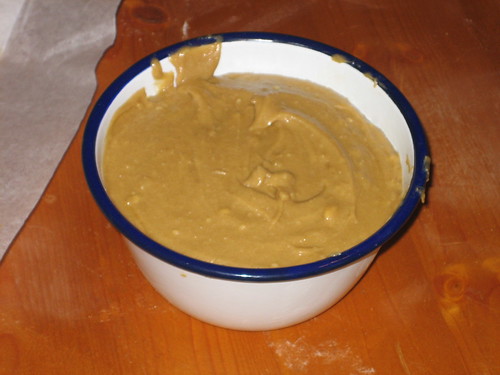
Whilst that was happening I whipped up the batter for dessert a traditional treacle sponge pudding, that was going to be steamed for a couple of hours. The recipe I was using was an all-in-one method, which was a bit of an arm ache since I don't have an electric mixer (mind you it burnt the calories the snowfall had prevented me burning so...). Here it is in the pudding basin.
Remember when making steamed puddings put a string handle on the basin before it goes anywhere near your steaming set up. Also with this one it's going to expand, so make sure you put the pleat in the top covering its going to need it. With all that in mind I wrapped the pudding safely and then found a handy secondary use for crumpet rings as they can be used to keep the basin a lot higher up in the pan so you don't have to keep a very close eye on the pudding boiling dry. The pancakes had cooled enough by this time so it was out with the duxelles and the spatula to coat them. Your fillet then needs to be seared, do this in your favourite way (a quick flaming with brandy is always fun) and then let that cool (yeah there is a bit of waiting about with this recipe).

Beef Wellington construction then begins. Roll out a rectangle of pastry big enough to envelope your beef. Lay the duxelles covered pancakes mushroom side up on the pastry & then lay your fillet in the middle of them. Seal the fillet in the pancakes, then to make things a bit neater & more secure flip the fillet over so the pancake seam is in the middle of the pastry. Seal the beef & pancake construction in the pastry and give it a good egg wash & make sure everything is sealed up, decorate if you like and put in a couple of small steam vents, put aside till about 30 mins before serving. Get the oven warmed up to gas 4 and set your potatoes & veggies going. The beef wants to go in for 25-30mins .As somebody once said to me, "if you aren't going to eat the beef pink, then don't bother with this recipe, its a waste of your time & money".
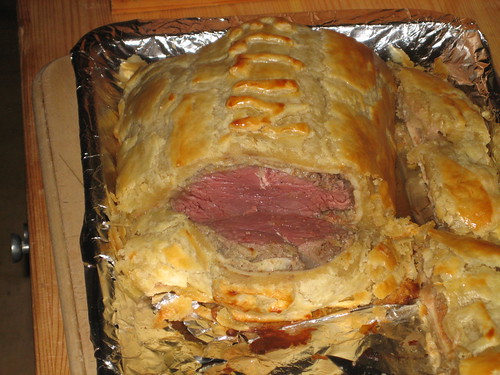
Let it rest for 5-10 mins & then cut into it.
As you can see I went with rare, rather than medium. The pastry grows & the meat shrinks, so you end up with a bit of extra pastry ends. I was really worried about this dish once it went in the oven, beef fillet is an expensive cut & I was scared it was going to get ruined, fortunately that didn't happen. Between the five of us we managed to eat the entire Wellington, not bad for a 750gr fillet, even the meat free bits of pastry from the end got eaten and one person actually had 3rds of this incredibly rich confection. I was holding back, because simmering away was the pan in which the treacle sponge was steaming.

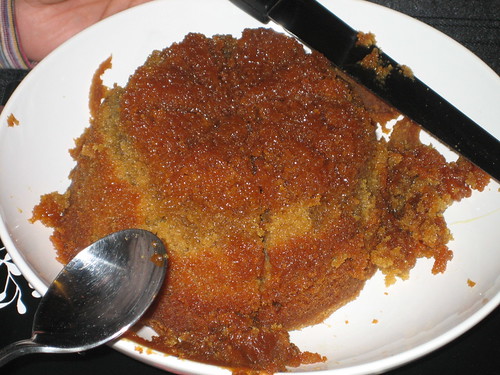
Another success (phew) even if I didn't grease the basin quite thoroughly enough or allow for the amount of expansion I should have. Serve with crème fraîche ? I don't think so, its not going to make an appreciable dent in the vast pile of calories that you are consuming by simply sticking your spoon in a treacle pudding, so treat yourself and go with real cream or in our case clotted cream. Somehow 3 of us managed seconds on dessert. So there we have it a hugely calorific meal, given the cocktails before hand (a nice Gin & grapefruit number that I'll talk about in more detail later and the wine (a pair of good new world shirazs) I dread to think what we actually consumed. It was a success & I'd be happy to do it again, but its definitely a winter menu.

Sunday, 31 January 2010

Treacle tart a la hairy

Yup the hairy bikers do treacle tart to. Its as lot less forbidding than Heston's recipe, taking up  a mere half page of text. The pastry is a lot less rich too. As you can see.
I'm only going to use half that butter, so its a much more standard pastry making procedure, cold hands cubed butter, 15 mins rubbing in. We also get to skip the fridge hokey-cokey that the tart bases required in the perfection recipe. In fact its even suggested you make the filling first to give it time to soak into the breadcrumbs properly.
The pastry came together ok, but didn't fill the house with the wonderful scents from the perfection pastry, but then it didn't cramp my hands & lurk in the fridge either. Also when the hairies say enough for a treacle tart to serve 6, they are much closer than Heston's mass catering effort. My friends & neighbours won't be pleased though. I was planning on leaving the golden syrup unaged, till I found the tin on the back of the shelf which had aged quite nicely on its own, in fact it had aged enough to separate. That's an easy thing to take care of, just heat the syrup & stir. Heating the syrup is usually wise anyway coaxing a full tin of cold syrup out into a bowl is a real chore. Remember to loosen the lid though or you'll have to duck.
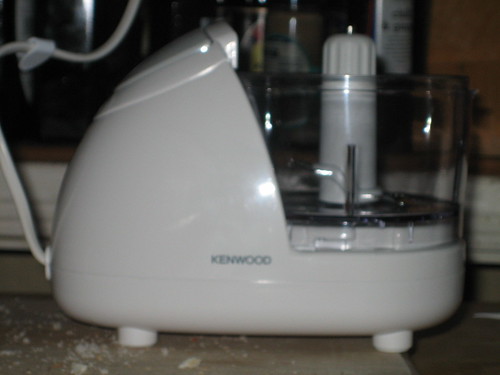
The internet solved the breadcrumb problem quite neatly. Behold the mini-chop. Whilst my kitchen is in need of the TLC only a partial rebuild can supply this is very useful, taking up very little space and being on hand for choppy jobs at a moments notice. I expect as we head toward the warmer time of the year it'll be pressed in to making curry  pastes and the like.
The filling was really simple, using a bit of lemon zest, rather than buerre nuisette from last time. The whole lot went into one blind baked case and into a slow oven for half an hour.
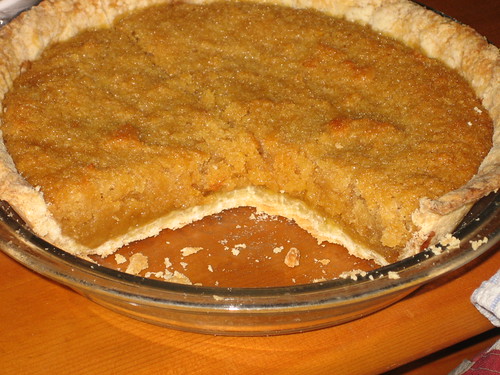
Onward to the bit you've been waiting for.
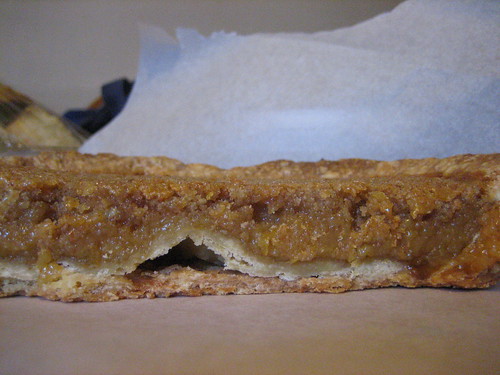
As you can see the filling is denser & deeper than the perfection tart. The pastry is probably a little better made than the perfection pastry, but that might just be the fact its a more standard short crust. What you can't tell is that it's no where near as fragrant as the perfection tart. It tastes like treacle tart, good treacle tart. Unfortunately it can't really measure up to the gold standard that Heston sets. That said this is pretty easy to make, and not much more than 2-3 pounds worth of ingredients. The perfection tart costs more to make and requires a much larger time investment, but the results are worth while. Keep this one for quick entertaining (or cynically guests you are less fond of) and break out the perfection tart when you have prep time and really want to impress

Monday, 25 January 2010

Crumpets v Pikelets take two

The last lot of Crumpets using the Hairy Biker recipe where good, they just weren't good enough. The purpose of crumpets (and pikelets) is to form a toasty matrix for holding molten butter. It turns out that Hugh Fearnley-Whittingstall has a recipe (well more a sermon on tea-time treats). I thought I'd give it a whirl.

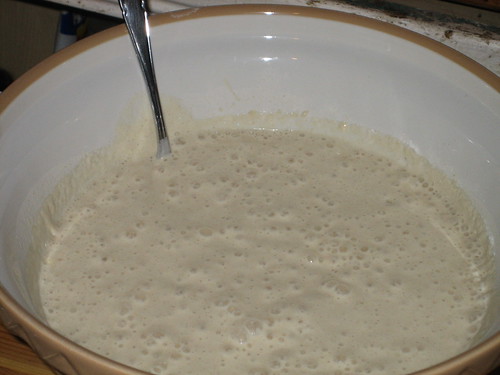
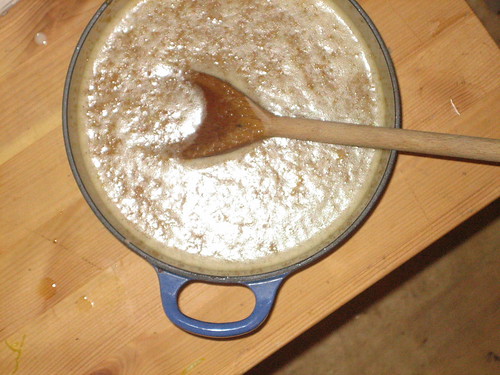
Thats the batter there, after the yeast has done it's work. The batter is a lot thinner this time round, more the texture of thin cream than the doughier batter of the Hairy recipe. Time to heat the skillet and find out what goes on. Hugh Suggests a test crumpet, which by tradition wil be sacrificed to Chef's privilege so I'm all in favour.

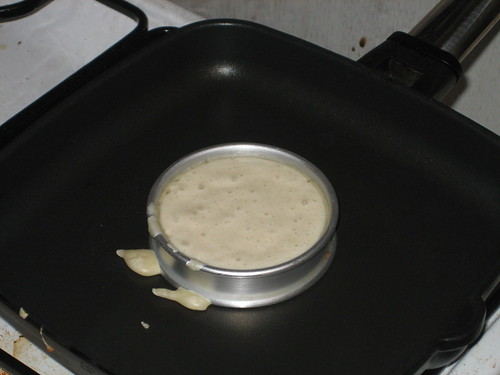
I was a touch sloppy getting all the batter into the crumpet ring, but the 2 important points are on display, 1 bubbles, and bubbles make holes, which is why we are making crumpets in the first place. 2 the batter is staying in the ring, its not oozing out of the bottom, so we've got the correct proportions. What follows is about an hour with the skillet & crumpet rings, but Hugh insists that pikelets are just flat crumpets (a position I've opposed for a long time, but since I've failed to find any evidence to back up my stance, I'm reluctantly agreeing with Hugh & others). This does though mean that I can get a nice system running where I alternate between crumpets & pikelets & get to clean the crumpet rings without wasting gas.

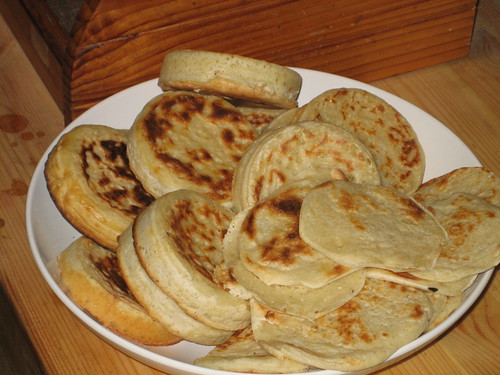
Well here they are pikelets, the store bought ones of my youth were actually a bit more circular & a little less rustic than these. Even so there is a good deal of promise being shown. At this point, if you've never enjoyed crumpets or pikelets you are probably asking yourself "Why is he so worked up about this ?". Well, pikelets have a different mouth feel to crumpets (in my opinion a superior one) that these experiments lead me to believe is due to their thickness. In both its possible for a hole to extend through the entire depth, of course with crumpets being several centimetres high, its unlikely, pikelets however are more in the order of millimetres thick, so it becomes highly likely, and when done right the majority of holes reaches the thin batter base. This provides for a much stickier eating experience, with pikelets trapping more molten butter. Here as inspiration is the bounteous harvest of teatime goodness

Monday, 18 January 2010

Treacle tart a la Blumenthal

Probably the first thing you heard about Heston Blumenthal was "snail porridge" or "bacon & egg ice cream". They are both great dishes, but to the man in the street it seems more shock & awe than cooking. So a couple of years back when the BBC commissioned "In search of perfection" I tuned in. The first thing I saw was his treacle tart program. Him & his research chefs made a vast array of syrups, from scratch and then tasted them and came to the conclusion that "The one in the familiar green tin"1 was the best. That pretty much sealed my fate, after all how many 3 star chefs after experiment say buy the ingredient from the local co-op !

So when I got the book of the series I enjoyed reading it and started to look for a recipe I could give a reasonable go to, after the burgers the tart looked like a good bet, I was aware that some step would be given in an offhand manner, which to the home cook would take hair-pulling, teeth gnashing fury. I didn't expect it quite so early though. Here are the pastry ingredients.
 Yes that is a lot of butter & its about to cause me some grief & the most work of the entire recipe. The pastry is 400g of plain flour & 400g of unsalted butter (yup co-op's finest there). The recipe gliby says "you may have to add the butter in batches" The reality is you absolutely have to add the butter in batches, rubbing it in is going to take an hour or so, keep ice water to hand so you don't overwork the pastry. Once you got it down to bread crumbs you make it even richer with icing sugar, 2 yolks, 1 egg, the zest of a lemon and the seeds of a vanilla pod.

It seemed quite sticky at this stage, but prior to letting it rest in the fridge (for at least 3 hours, making my fingers thankful) I weighed it. 1.1 kg of pastry, and a vanilla & lemon scented kitchen. Good stuff. Only 2/3rds of this monstrous ball of pastry are going to be used according to the book, but that's not how it happened in my kitchen. The next issue was breadcrumbs, they are horrifically difficult to make by hand, in fact so difficult I had to go and cadge some food processor time off my neighbour. Back to the now rested pastry time to roll it out. The recipe tells you to do this between floured sheets of greaseproof paper which does make life a little easier, I'm sure I seen another TV chef credit Heston with this, but it seems a bit unlikely. Rolled out dropped into a buttered flan dish /tart plate (or in my kitchen 2 medium ones) and back to the fridge, this is some well rested laid back pastry. Half an hour later its back out the fridge, prick over the base, load up with greaseproof and baking beans (or whatever you use (HB suggests coins)) and take it back to the fridge for another rest. Time to pre-heat the oven. Once that's happened & the pastry has rested (30mins later) in go the tart cases to bake blind.

Lets have a look at the filling. Ok eggs & cream, then salt & vanilla. Quickly whip up a buerre noisette.strain & filter it and put it in a pan with your 2 tins of golden syrup (that's just under a kilo of refined sugar goodness ( A quick aside, treacle tart is even in its meanest incarnations a rich dish, if you are counting calories, don't make this)).
The heated syrup is a lot easier to work with than cold syrup.

This gets combined with the bread crumbs, some lemon zest & juice and the  egg & cream mixture. This then gets transferred to a jug to fill the tart case(s). There is a puzzling instruction at this point. "Fill the case with 2/3rds of the mixture transfer to the oven & then pour in the remaining mixture" The quicker witted amongst you will know why, I found out. Its so you don't slosh treacle mix everywhere. Time to relax while a nice slow oven works its magic on the treacle mix. An hour later and viola a treacle tart, or maybe 2. Having had little luck getting dry ice, I skipped the ice-cream, made a cocktail out of the egg whites & lemon juice and sat down with the neighbours (only fair since they lent me the food processor) and dug into still warm tart.


Oops, didn't quite get the pastry flat, but its vanilla/lemon scented goodness lifts the tart beyond the mundane, before you get anywhere near the filing. As you can see there is a crust over sticky goo, this is exactly how treacle tart should be. The top is on the edge of crunchy, and not dry in the slightest. Is it perfect ? Well with the burgers its very difficult to find a good burger in these parts, treacle tart however is easier, and I've eaten my fair share. From WI tart to corner bakery varieties, from cheap no frills to taste the difference. This is the best, everything about it is right, when I make it again, I'll be using slightly more chopped lemon zest, but that's about it. Oh yes the quantities, Heston does overshoot, and I can see several reasons why. The book says 8-10 portions. I'd say its more like 12 & then you can use the spare pastry & treacle mix to make individual tarts for deserving co workers.

To see more photos go here
The cocktail recipe will appear shortly
1 For those of you unfamiliar with the BBC they have to be quite careful about brand names, the tin in question is the familiar (to most of the UK)  green Tate & Lyle golden syrup tin. Yes that is a dead lion, and no those are bees not flies.

Monday, 11 January 2010

The great pikelet conumdrum

Having successfully made crumpets I turned my thoughts to that great childhood favourite the pikelet.

My memory seemed to think that in amongst the family cookbooks was a recipe that suggested there was a fundamental difference between the two. Time to consult the internet (it's reasonably well indexed, so you can work back to accurate).

Disaster ! 


It seems the word pikelet covers a whole host of delicious toastery snacks. The Welsh seem to thing its a kind of drop scone, some people think its another word for crumpet and the Australians seem to think something else again. So I'm talking about a thing that's been  griddled has holes in the top (like a crumpet) but is under about 5mm thick. General opinion is that they are just crumpets made without crumpet rings. Hugh Fearnley-Whittingstall is in this camp, but interestingly he adds more flour to the pikelet batter,I think that will do for me.

So once this snow/freeze lets up and my kitchen is more amenable to yeast I'll have another stab, maybe tweaking the crumpet recipe a little and trying to pikelet some of them.

Thursday, 7 January 2010

Recipes

I was watching the hairy bikers new show the other night. It's all about family recipes, one of the problems they've had in collecting the recipes is that if they are handed down through the family there isn't much of an actual recipe. This got me thinking, I have a stack of recipe books, plus the internet, plus a couple of apps for smart devices but how do I actually use them ?

Nigel Slater & Hugh Fearnly-Whittingstall tend to be goto books for meat cooking times . Jamie Oliver & Nigella Lawson (happy birthday for yesterday) for cakes & pastry. The Hairys, Heston and the Two fat ladies mainly provide inspiration. (Though I am making Heston's treacle tart, his recipes are very exact). McGee whilst not exactly a recipe book gets consulted when I'm trying new stuff as it provides information about the presence of ingredients. Then I know if I can leave them out, substitute them or have to stick with them, rather than trial & error.

Looking at several things I've posted, I don't give recipes, I'll occasionally link to one but in general, I'm all about some, or a pinch. Pastries, doughs, and batters I weigh out, Indian dishes I do use a recipe quite heavily to get the right proportions of the right spices.

Tuesday, 10 November 2009

Perfect Burgers ? (pt2)

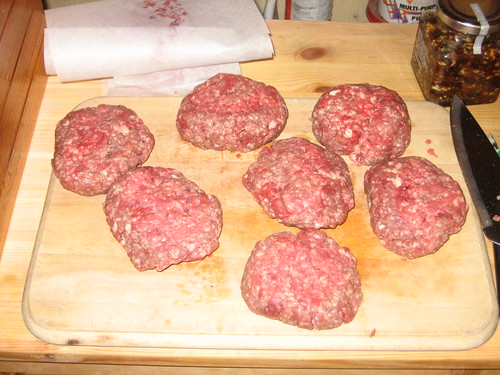
Time to take the logs of meat from the fridge & turn them into burgers. They ought to be approx the same diametre as the buns and about 2 fingers thick, the cold & the cling film combine to make this step a bit easier. then roughly shape them into burgers


There they are, if you have more burgers than people, wrap them in baking paper and then freeze them, they should be good for 3 months, but I doubt they'll get a chance to last that long.

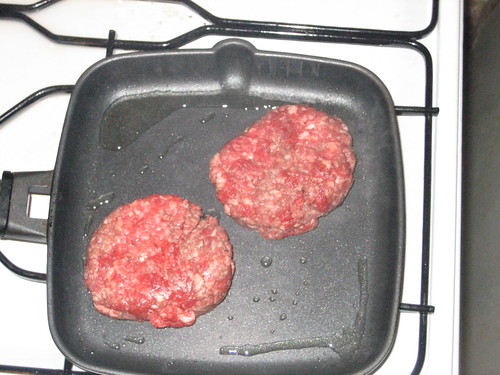
So to cook them, get a skillet very hot (5-10 mins on full heat) and oil it lightly.
Then put the burgers in.


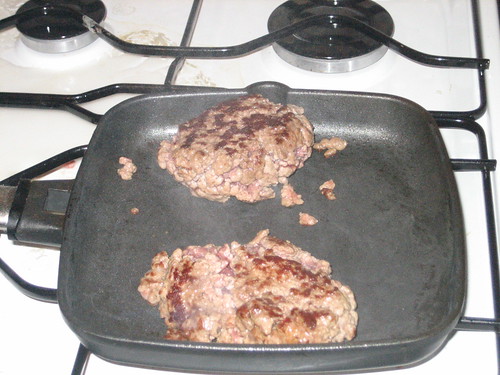
Now the instructions say turn every 30s, this allows a crust to form on the outside, but keeps the centre moist. I don't think I'd managed to get the pan hot enough, because after 2 mins they were more blue than rare/medium rare, so more flipping and more cooking.

Hot hot hot, flipping every 30s there is almost bound to be a casualty or two, in this case it was light flaking of the burgers.
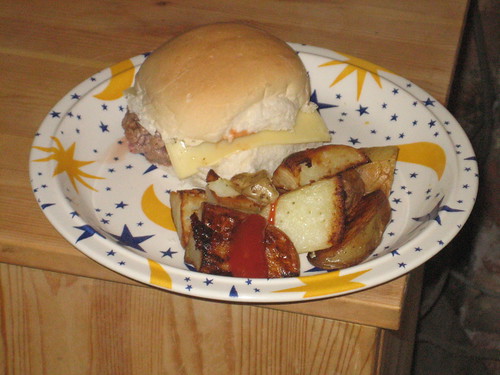
Since I'd skipped out on doing the whole job, I'd got some buns, cheese & Mr Hienz's ketchup. Instead of going to the chip-shop I made some wedges, the healthy alternative.


That's making me hungry to look at now.

So are they perfect burgers ?
I honestly don't know, they are very good, but this is the first time I've made burgers from scratch, and having traceable meat meant I could eat them much rarer than I would dare with store burgers.
The texture is very good, does aligning the mince make it so ? Probably.
Am I going to do it again ? well not for a while, I've still 10-12 burgers in the freezer, and they are reasonably expensive (Figure about £1:50 per burger, obviously it depends on the cost of the meat though, if you are going to do the whole thing, its going to be closer to £5 per burger.

Its shown me a couple of bugbears with the book, that I'm more prepared for now. Kitchen organization is an absolute must, because the odds are you are working in a family kitchen, complete with all the things competing for that space. Several of the recipes call for long processes, 6 hours in the fridge is nothing compared to making a pre-ferment 24hrs early (thats if you want to use the HB buns) or the amount of cooking the Chili uses, that said, its not exactly arduous and with a bit of experience I'm sure you can adapt the recipes to be even more usable in an average home.

I don't know if the burgers are served at the "hinds head" in bray, but I'd not be suprised to see them on the menu at around £15 which doesn't seem that unreasonable, especially if they come with triple cooked chips.

I did notice the mincer has a sausage nozzle, the book has a bangers & mash recipe and it appears that Heston & I share a taste in sausages (Pork, a little spicing, no herbs or that kind of nonsense) so I could try that next.

Perfect Burgers ? (pt1)

At some point I made a rash comment I was going to make something  out of one of Heston Blumenthal's cookbooks. A chance encounter with a cut price mincer lead me to his Hamburger recipe. The full thing which includes making buns & cheese slices is a somewhat daunting 30+ hour oddesy. So I chickened out and went for just the burgers, the theory being that when I come to do a full recipe I'll have an idea of the pitfalls.

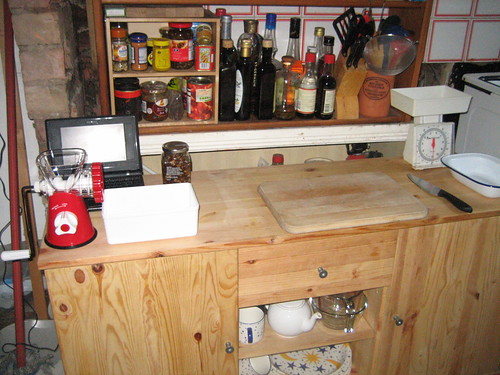
First set up a workspace, its probably not going to be big enough, because its very unlikely you are a michelin starred chef , even if the perfection recipes are meant for the home cook (A slightly nerdy obsessive one at that).


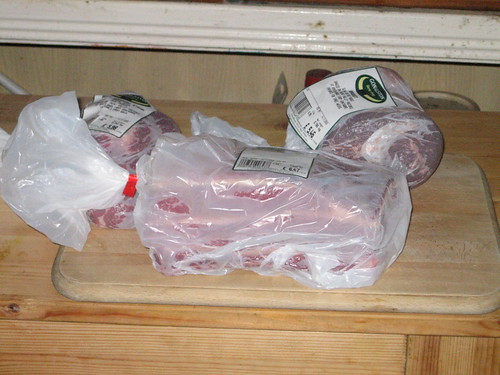
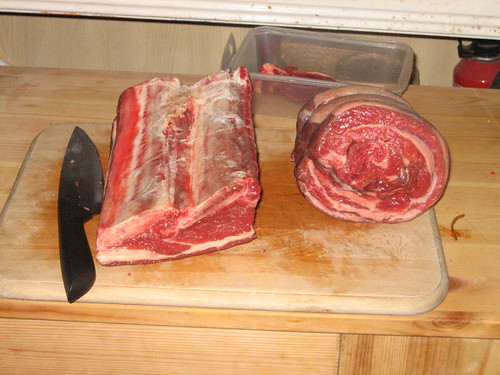
There we go, ahh the folly of youth. Then meat, specifically beef,more specifically 625g chuck, 625g brisket, 1.2kg short rib.


Short rib is a bit of an odd cut, after much discussion with 3 butchers (including a South African (I mention it as they really seem to know meat))
flat rib was suggested as the correct cut.

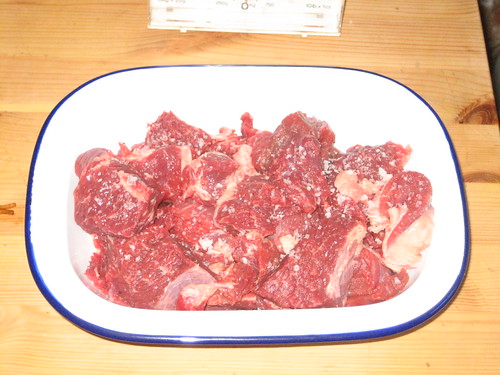
First off dice the chuck and then put it in a dish with some salt (a teaspoon full ) and then let it sit in the fridge so the salt can draw out the juices.


Looks good, but no time to admire it as there are 2 more cuts to dice


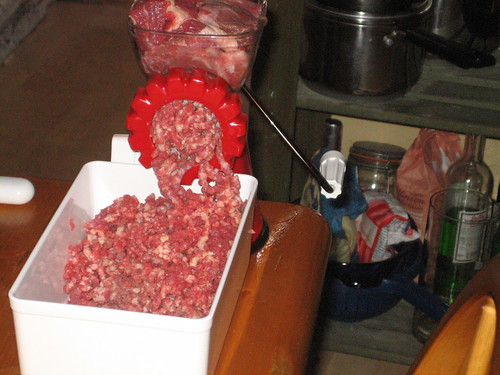
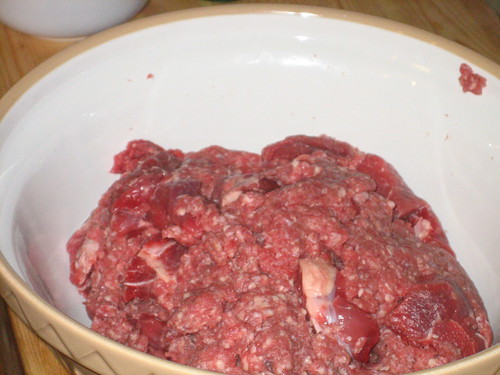
And then mince, not once, but twice, through a reasonably fine mincer too. My mincer is a hand crank one, this is going to give me lats that some would kill for.


 Lots of mincing happens, fortunately I'm getting 4-5 hours rest whilst the chuck & salt do their thing, unfortunately this meant I was getting rest from the kitchen, there were other chores to do.

 Now I've got a bowl of twice minced beef & a bowl of unminced chuck, that all needs mixing together, this is almost the home straight.


Or so you'd think, however this next mincing has an attention to detail that is a hallmark of molecular gastronomy. Several tests Had Heston thinking about the texture of his burger, he solved it by putting the final mince through a coarse plate, and most importantly keeping the mince aligned as it came out.
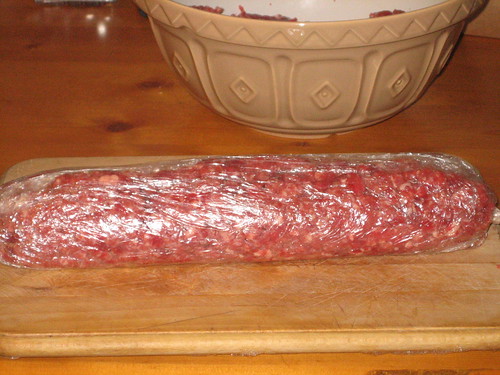
The stage is a bit awkward, even with an extra pair of hands. It should be coming out on to cling film, then you can wrap it into a beef log.


You can probably see meat in the bowl behind the log, there was no way the entire amount could go in one log & the fridge, so I separated the mass into two. Logs safely rolled it was time for more chilling. The vaguries of the weekend meant that the actual cooking would be the next day.


Tuesday, 22 September 2009

Bacon cake

I'm not talking about this kind of vileness, no I'm talking about something you might want to eat.

Rather it's a two fat ladies recipe, probably one of Jennifer's. Anyway its basically a (boiled bacon) pie. So how to make it ?

First you'll need a bacon joint (gammon works well), either cooked already or you can cook it yourself, its up to you.

Once you've cold cooked bacon, slice it, shred it,pull it off the bone. What you are after is a big pile of bacon slivers. These form the stuffing of the Bacon cake.

Then you'll need some pastry, The recipe calls for a short scone type pastry, due to a bit of a kitchen mistake, mine ended up half lard, half butter. Of course pastry making can be hassle, so feel free to use store bought (but not puff pastry, that would be so wrong).

Halve the pastry & roll out a 20cm disk. Load it up with your bacon slices, making it taller in the middle and leaving a 2-3cm gap round the edges. Roll out a second identical disk from the remaining pastry & drop it over the top. Get any trapped air out and crimp the edges of the two disks together.

If it's anything like mine you should be looking at a giant round Cornish pasty. Prick or slash the top disk after all we don't want it to burst in the oven. Put in a medium slow oven (gas 4ish) for 25-30 mins or till the pastry is golden brown.

You can now cut & serve it, but my preference is to let it go cold & then slice (as best you can) into portions.

Lovely