Showing posts with label Heston Blumenthal. Show all posts

Tuesday, 13 September 2011

In search of perfection:-Bangers


Ahh Sausages. I like the good old banger, in fact I like it better than some pure meat sossies. Heston Blumenthal had a look at Bangers (& mash) in his perfection series, and the banger needs filler. These are pork, some spices a little rusk & toast water. Like all HB recipes there were lows & highs. Most of the issues with this one were due to having an ordinary kitchen, with a fullish fridge & freezer.

First off make toast, but make it in the oven, at gas mark 4 for 30 minutes or so. Whilst that's happening fire up the BBQ, you are about to char pork back fat over smoking woodchips. This was my first arghhh moment, my wood chips were a bit too wet and smothered the charcoal, still a blow torch rescued that.
Once  the fat starts to go things get quite exciting in the BBQ. Gloves & eye protection are recommended as a lot of hot fat spits around. Once its all charred, blistered (and smelling awesome) take it off the heat & pop it in the fridge to cool. Also in there will be a large bowl of water & toast, oh and the pork mince. Cold is quite a vital part of banger making, the fat & meat (and spices & filler) need to emulsify, let it get too warm & it'll split. Blitz the charred fat and it looks pretty unpleasant.
Chill down the bowl & blade on your food processor & blitz the mince in batches, it needs to be smooth & not to rise above 10c. I have a tiny food processor, so this & the next stage were quite hard work and could be an area of improvement for my next batch. The meat and food processor bits go back in the freezer to get everything down to close to 0c, whilst you blend the spices, rusk, golden syrup  and toast water
   That gets to chill too. Then you blitz all the bits, fat, spicy toast water & meat again in small batches keeping a check that they never get above 10c, whilst that's going on let the sausage casings soak (put the now sausage meat back in the fridge to chill)
   Then its time to stuff your sausages. If you can get help with this part do. 2 pairs of hands make it pretty easy. Having spent a few hours getting to this point, surrounded by lumps of fat, piles of meat & collections of spices I was pleasantly surprised to see sausages magically emerging from the combination, mincer, pasta maker sausage stuffer machine.

  To enjoy them to the full Heston recommends poaching at 65c for 320 minutes & then frying, I couldn't wait I had to try the sausages.

  Well worth it.

Yes its fiddly & a bit of a pain, no its probably not hugely economic to make small batches (we got about 15 bangers) but your own home made sausage is a pretty awesome thing. I've got casing left, so I might have a stab a Lincolnshire style next. Unless that is you know where I can get some hippopotamus.

Tuesday, 7 September 2010

Tarte Tatin

Windfall apples, what to do ? A quick glimpse at Family Food suggested Tarte tatin, after all what could be nicer than a caramel apple pie ?

For some reason I'd never realized that tarte tatin is cooked upside down, the recipe also called for frozen puff pastry. I skipped that as I was making my own shortcrust for some other bits.
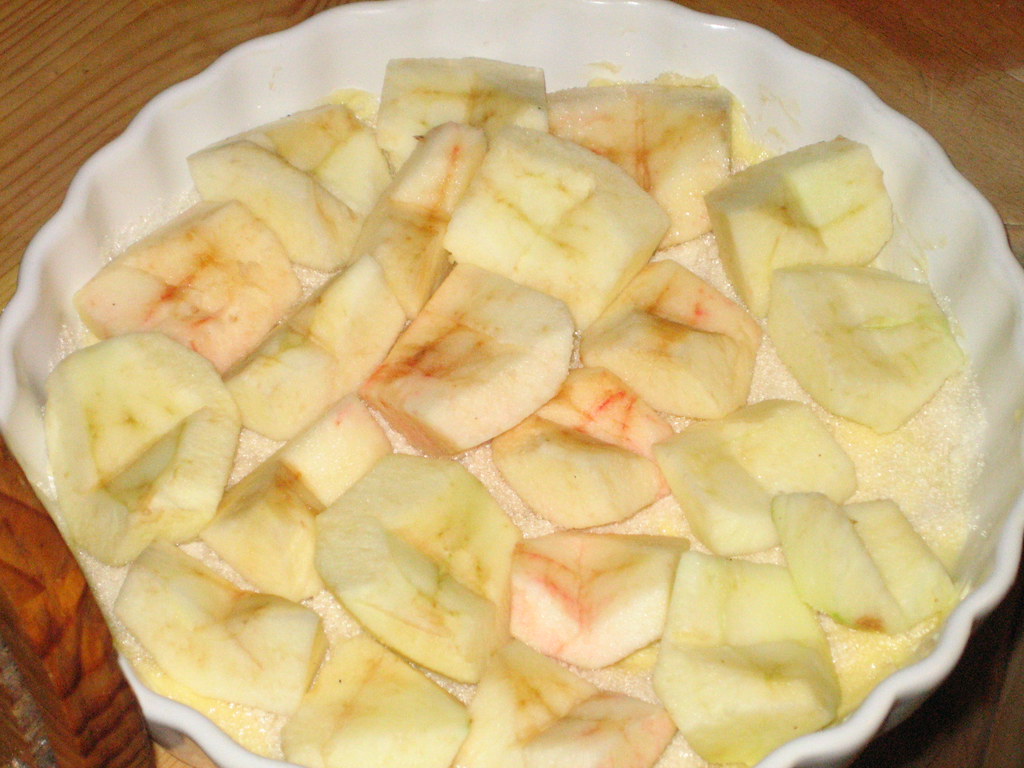
First off came lining the bottom of the dish with 100gr of butter. Then I sprinkled 80gr of sugar over that (Depends a bit on how sweet the apples are). Then I cut some wedges from my apples. This is great for windfalls as you can chuck the less good bits of the apple.

Once it's all set up put it on the hob at a medium heat & watch the butter melt & the sugar begin to caramelize. At this point the recipe suggested putting a plat over the apples to make sure they got nicely covered.

I looked at several pictures on the web and the apples are really deeply caramelized, to a very dark brown. I didn't go that far, taking it off the hob when everything was golden. Now came the tricky sounding part. Next time I make this (and its not going to be too long before I do) I'll roll the pastry & measure it first, it can rest at the right size.

I dropped it over the apples & tucked it in as best I could. You can see bits of buttery caramel escaping up the sides. So it wasn't going to be the worlds best looking tarte tatin (I think that goes to those with the regular spiral of thin apple slices), but hopefully it was going to taste OK. With that it went into the oven on Gas mark 4 for 30-40mins (depends on the oven, whether you've pre-heated it and all those other factors).

Then comes the nailbiting section, turning it out. Place a plate over your flan dish & quickly invert, perform what ever voodoo you regard as acceptable & tap the flan dish, if everything is going you way you'll hear a flopping sound & then the big reveal.

Eat with cream, or ice cream (I like ice cream when the tart is warm & cream when its cold). The next day I was idly poking around the internet and several websites suggested that Tatin was a difficult thing and reading some of the recipes I'm not surprised. This was pretty straight forward, and if you aren't good at pastry, Jus-roll and similar work fine. If you've an abundance of apples this is worth a go, and the anxiety of turning out hot caramel is always a spice to an afternoon in the Kitchen.

Wednesday, 28 July 2010

Pizza !

Over at lifehacker they're pretty serious about pizza. Pizza is pretty nice, I can get one delivered with little more effort than opening a new tab on my browser, so what's the fuss about ?

Homemade pizzas
Turns out pizza is one of those things worth the hassle. Heston Blumenthal goes into his usual depth when he makes pizza in "Perfection" Kilos of tomatoes get used, dough is prefermented and so on. The main thing he talks about though is the temperature at which the pizza gets cooked. Wood fired pizza ovens are really hot, hotter than you can get out of a domestic oven. Fortunately there are some simple solutions to get you started.

First, dough. My pizzas were made with a simple flour,water,yeast and salt dough. It takes about 10 minutes & doesn't need to prove though letting it rest always helps. Toppings, cheese & tomato are glutamate rich, so a well made pizza should have a strong umami flavour. To get my tomato sauce I butchered a ketchup recipe leaving out the sugar & the final reduction and fiddling with the seasoning (Basically I left out the spices & added more herbs). Takes about an hour, though most of that is the sauce bubbling away on its own. The 2 pizza halves up top are potato & prosciutto (top) and Salami & mushroom (bottom). To cook them I used the skillet method, heat a cast iron pan on full heat for about 20 minutes, meanwhile get the grill going at full heat.
Slip the prepared pizza onto the bottom of the skillet(*) and whiz everything under the grill, 2 minutes later you have pizza. Really good pizza, OK it takes more than opening a tab on your browser (I had to do that to get the dough recipe) but the taste is worth it.

(*) Sounds simple, it's not. You are going to be wrestling with a floppy circle of dough, loaded with sauce,cheese & toppings and a ferociously hot pan. Get help, make sure you've got tools and take care. 

Wednesday, 2 June 2010

Millionaire's shortbread part II

The first attempt went quite well but I wasn't entirely happy with the biscuit. Whilst the olive oil biscuit base might work very well in the context of one of Heston's menus it's not quite right for just scoffing. The quick shortbread I used for the Public sector version didn't really cut it either.

I found another HB recipe, that the Times published (which I found by a bunch of people complaining that the Dulce de leche step took  3 hours) for a simplified version. I used the short bread from that which worked out quite well (that's it to the left) and had much more of the texture that I associate with Millionaire's shortbread/caramel squares.

The salted butter caramel from the FatDuck cookbook was really good, I'd had a couple of issues with it, that I was hoping to resolve with the purchase of a sugar thermometer and an untextured pan. Whilst it worked better than before (and seems to have created a very rich sticky caramel) I still had issues with it sticking & singeing.
Once again rolling it out & cutting to size was very tricky, hopefully The big fat undertaking will be making the full recipe before too long (though I think the chocolate wine may require a centrifuge) and I'll have another source of reference. The tempered chocolate though is definitely a step not to miss out, there are several easy ways to do this at home, that don't involve water baths or marble slabs and the end product is glossy chocolate with a real snap.

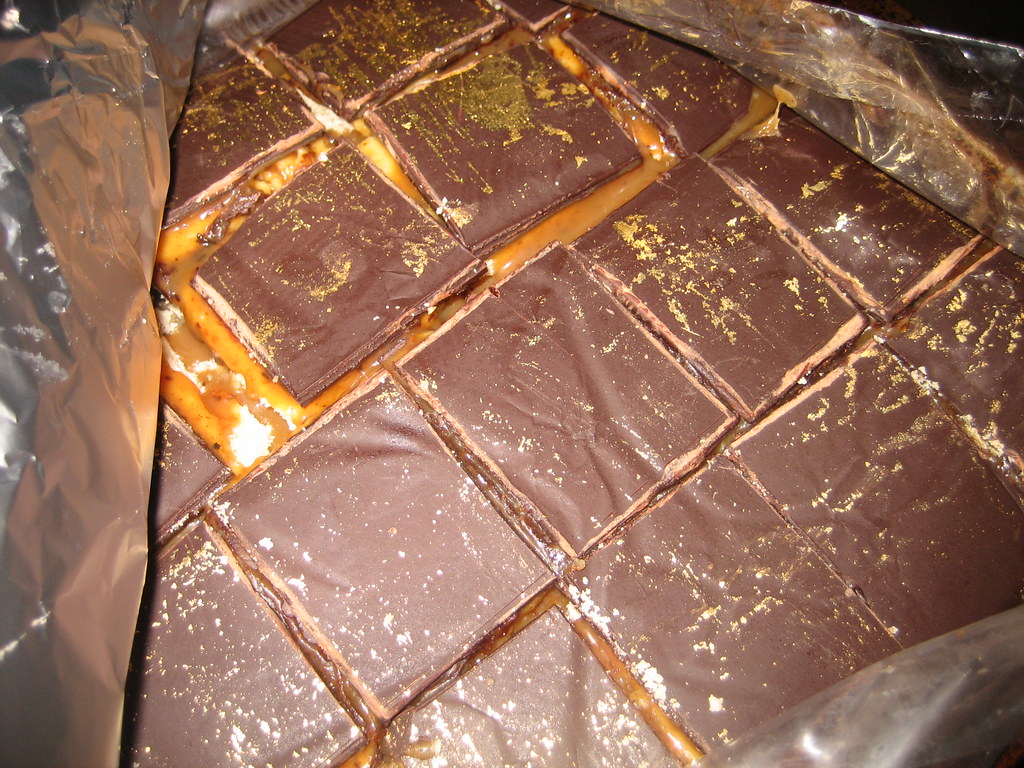
Assembling the squares isn't to bad. This time round I'd decided to make one giant piece & then cut it to size, which makes working with the sticky slab of caramel easier, but means you have to have a bowl of hot water handy to slice the chocolate layer.

I've tasted the trimmings and its pretty much close to my ideal of Millionaire's shortbread, a crumbly base, sticky caramel and an intense chocolate hit. Given the richness of the caramel (it uses both butter & double cream) you have to be a bit careful with the base (I crossed off one recipe that used 500g of butter) and its best to use a high cocoa dark chocolate for the top (otherwise I think it could get too cloying).

I might have a go at the Dulce version in the future, but to be honest I'm quite happy to go to the trouble of making the caramel & tempering the chocolate.


Wednesday, 5 May 2010

Triple cooked chips

(note for Americans, I'm talking about what y'all call fries)

That man (HB) has made a quiet, but extensive contribution to British food with the triple cooked chip. Hardly anyone who knows their way around a kitchen uses any other method, even if they don't go to the extremes of dry matter ratios & refrigeration some recipes call for.

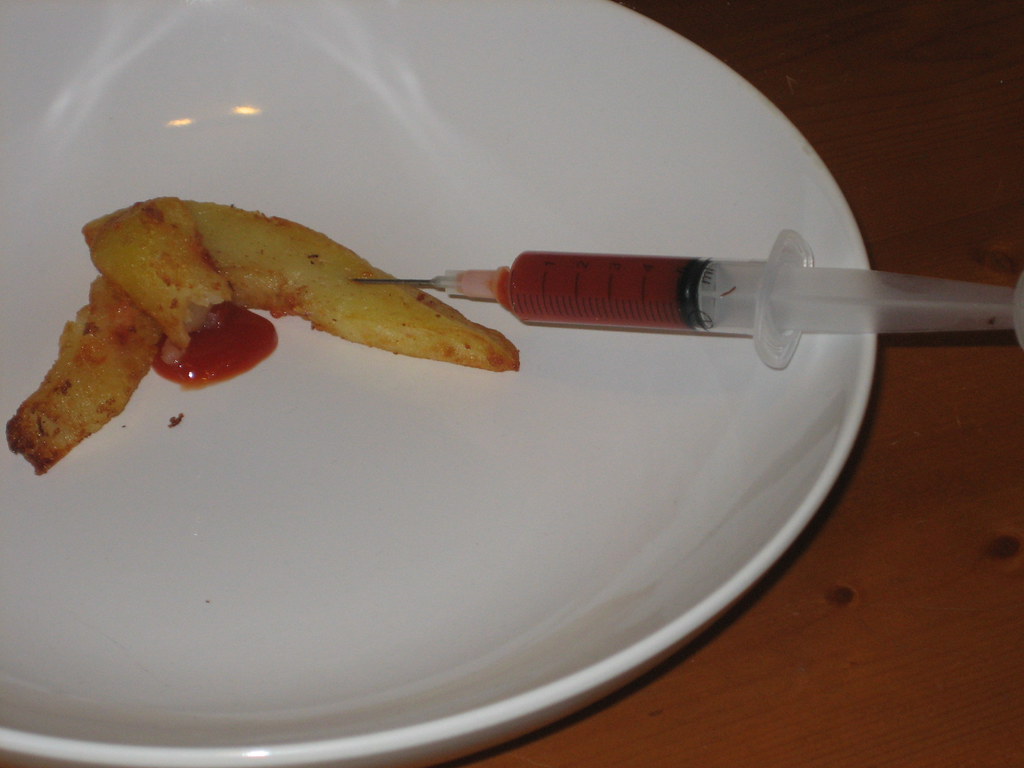
One of the earliest recipes I've seen is "chips cooked in hay" which has the added bonus of injecting the finished chips with ketchup.

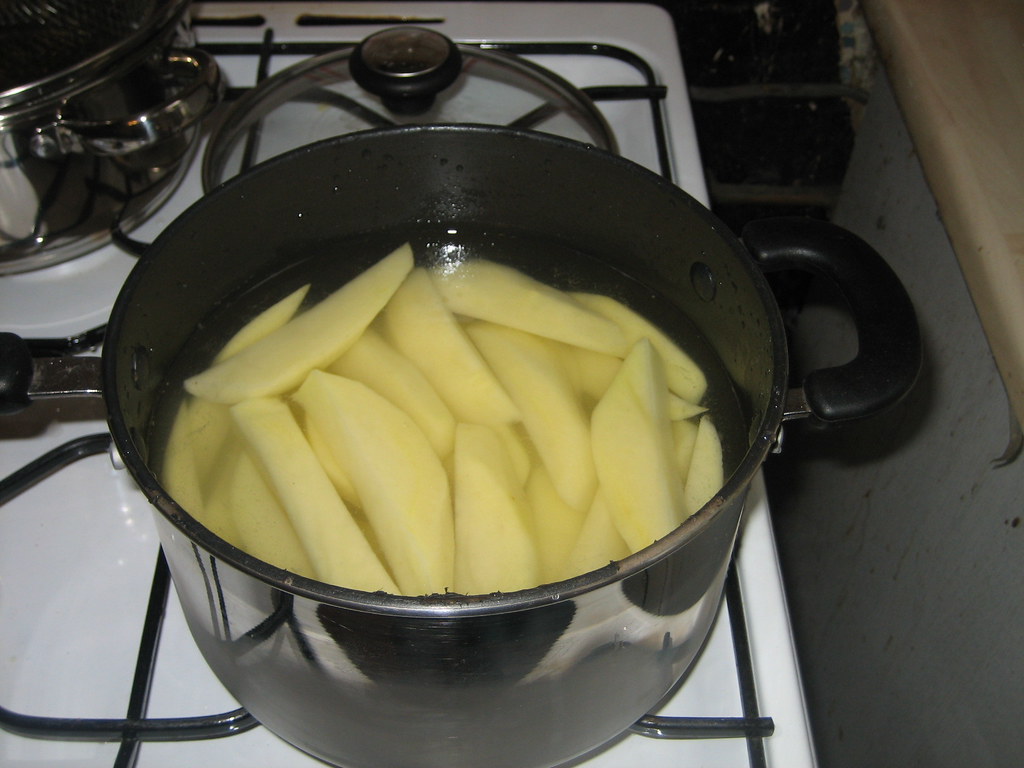
The first step is to wash the loose starch away from the cut chips, rather than run water wastefully I soaked & dumped a couple of time, then bring it all up to the boil & cook the chips. They want to be on the very verge of coming apart. This is where the magic happens, we are attempting to create small fissures in the surface of the chip which will enable us to form a starch glass in the frying stages. That ought to mean we end up with a good crunch & a soft fluffy interior.

Getting the chips out of the boiling water is the hard part. They are on the edge of falling apart, the chips are going into the fridge, for at least an hour, which has 2 main effects. 1) it helps dehydrate the chip, which we need when they are about to go in the oil (hot oil + water == very bad). 2) It firms them up, making it easier to handle with out them falling apart all over the show.

Next up hot oil, it wants to be 130-40°C for the first fry, this mainly to bring the chips back up to a cooking temperature, so they stay in until a crust has formed, it takes about 8 minutes  don't let the chips colour that's for the next stage. Crank the heat under the oil up & get it to a much more serious 190°C and cook till golden.
Drain and dry the oil off, now for the fun.

Getting hold of syringes is pretty easy, but nobody wanted to sell me hypodermic needles. I'm not sure if the sale is controlled or if most pharmacies just don't carry them. Fortunately I know people in the medical profession who seemed unfazed by my tales of injecting chips with ketchup & trying to get marinade under the skin of pork. I'll recommend sucking the ketchup up before fitting the needle, it seemed a lot easier that way.

One question that seemed to crop up without answer everytime this recipe was mentioned is "How much ketchup do you inject ?". Answers seemed to be lacking, which is because when you start injecting, you can feel the amount of ketchup going in, at a guess though I'd say a decent sized chip takes about a 1/3-1/2 a millilitre of ketchup since I was filling my 5ml syringe every 10-15 chips. Eat them whilst hot, really, they are excellent.

Oh yeah there is actually a reason to inject the ketchup, its to stop that lovely starch glass outer from going soggy & ruining the crunch you've been doing your best to create. Also try to have enough syringes for everyone to have a go (Well grown ups at any rate) it'll add a certain level of amusement to the proceedings.
(Oh yes I skipped the hay step mainly because I'm not convinced the hay I had was safe to eat, but once the spring lambs start to be more available I may do lamb baked in hay with hay cooked chips as a Sunday dinner.)

Wednesday, 28 April 2010

Fabulous feasts

I think its fairly obvious I'm a fan of Heston Blumenthal, so I'm an avid watcher of his TV shows. Here in the UK Channel 4 are well into the second season of fantastic feasts. The first series was responsible for my wallet damaging trip to Bray, to experience the Fat Duck for myself (nutshell, its worth it). This time round I've noticed more about how he reuses and revisits ideas & techniques.

Last weeks camel burgers are a straight remake of the perfection burger with camel instead of beef, served with the famous triple cooked chips (which once I get a digital sugar thermometer I'll be making). Last night he used the blood/black pudding recipe from "Balotine of Anjou Pigeon" in several places.The butter salted caramel from millionaires shortbread, also saw some use (in the fabulous graveyard dessert). I'd decided that I was going to use that if/when I next needed a caramel myself (of course I'll need the thermometer).

Anyway having made another batch of the burgers (the farm shop had some beef on offer & it seemed to make sense) ready for the BBQ I'm unlikely to use a different burger recipe as the results are so good, just goes to show how what initially seemed to be cutting edge & outre techniques are a lot more reusable than they first appear.

Monday, 12 April 2010

Tea Jelly

Another mention of that restaurant.

A couple of things left me with very strong taste memories, the first was the Douglas fir sherbet. I was out mountain biking a couple of months after eating at the fat duck & passed through a Douglas fir stand, instant hunger.

The second was tea jelly, I was reminded of it whilst doing research for the shortbread, since the chocolate wine was a definite no-go maybe the tea jelly would be good ? I wasn't holding out much hope due to the presence of exotic gelling agents in HB's cookery. Fortunately this used good old Gelatin. Malic acid was the weird ingredient, but its easy to get at homebrew shops.

The book is very precise about the water used, it needs to have a calcium level of 100-400ppm. I had a slight factor of 10 issue when converting to milligrams so ended up with a water having 36ppm of calcium (this may be important later).

It also needs 3 different types of tea, calling for earl grey, Darjeeling & green. I've got a fairly good idea about tea, so I used my favourite smoked earl grey and swapped the Darjeeling for a maloom and used a gunpowder green for the green tea .
Anyway you make a syrup of 2 kinds of sugar & then cool it to 4c. Then the lemon juice, malic acid and teas go in to infuse for a couple of hours, which you then strain to clear (I used 2 strainers, you can use a muslin if you want it really clear). Add the leaf gelatine to the mixture and heat gently till it's dissolved and refrigerate till it sets.

I'd not left myself a lot of time, and it didn't seem to be setting, so I panicked and put it in the freezer, all the while trying to work out if I had got my factors of 10 confused. I served it (more than a little dispiritedly) as a failed tea ice. The taste was pretty much spot on (I'm ridiculously happy about this as its a taste I really enjoyed and I can make it whenever I want) and it had started to gel so maybe my failure was time based ?
I've found a water with the correct calcium ratio, so I'll be having another attempt and I'll leave myself some more time.

Note for Americans, jelly in this case is similar to jello, not a preserve for spreading on bread.

Millionaires shortbread

Or as its sometimes known caramel shortbread squares.

Last year I ate at the fat duck in Bray, I got to eat many wonderful things and was given a copy of the big fat duck cookbook, the original giant 5.6Kg format. Now its a very very nice book, but it is full of recipes and they demand to be used. The shortbread (and accompanying chocolate wine) wasn't on the menu when I was there but I really wanted to taste it.

Some of the recipes in here are scary, the chocolate wine being a case in point, a centrifuge ? whey powder ? Gellan ? I know why these ingredients & techniques are used, but it can''t really happen in my kitchen. The millionaires shortbread didn't seem too scary. I couldn't get T45 flour, but knowing its a plain fine white flour allowed me to substitute.

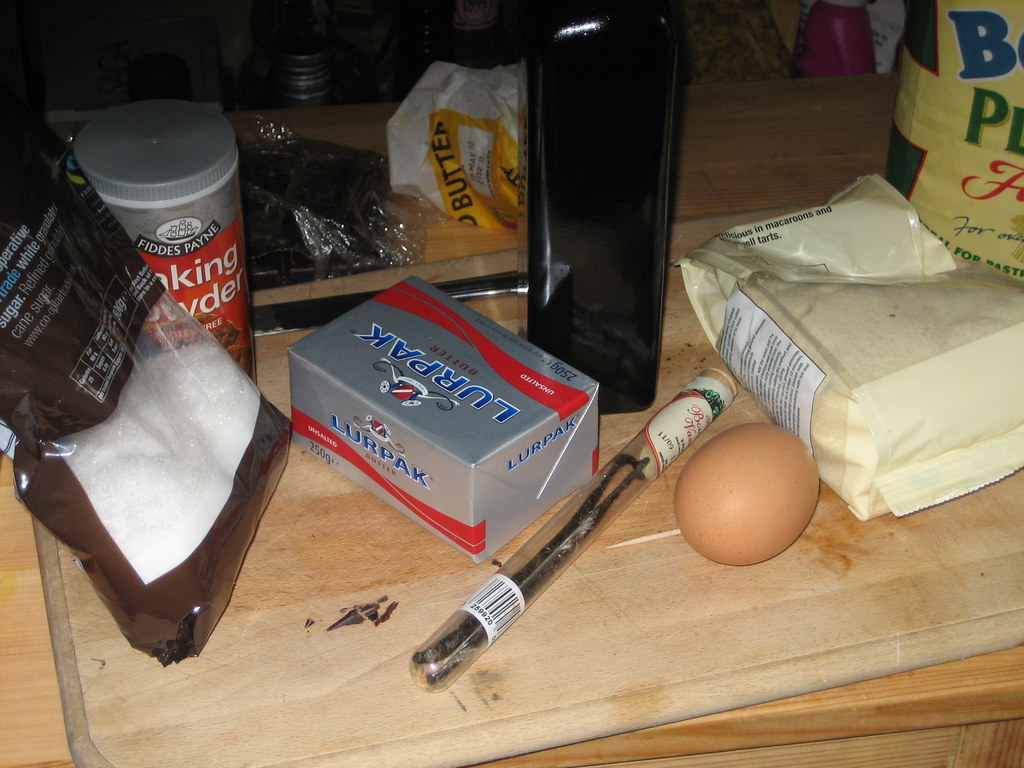
 Those are the ingredients for the shortbread. The method and measures are precise (this is a feature of Heston Blumenthal (HB) recipes). I needed 45g of egg yolk (turns out that is almost 2 co-op large eggs) and actual vanilla seeds, also required was olive oil, which came as a bit of a shock since I'm used to butter being the only fat in short bread. Due to a cockup with the amount of olive oil I had in I had to add a little mandrine olive oil. The dough comes together remarkably well but feels a bit sticky. It goes in the fridge to rest for 24hrs (look at the treacle tart recipe for HB's take on pastry resting) When it comes out you've got a rich firm dough, which you roll out very thin & return to the fridge to rest for a couple more hours.

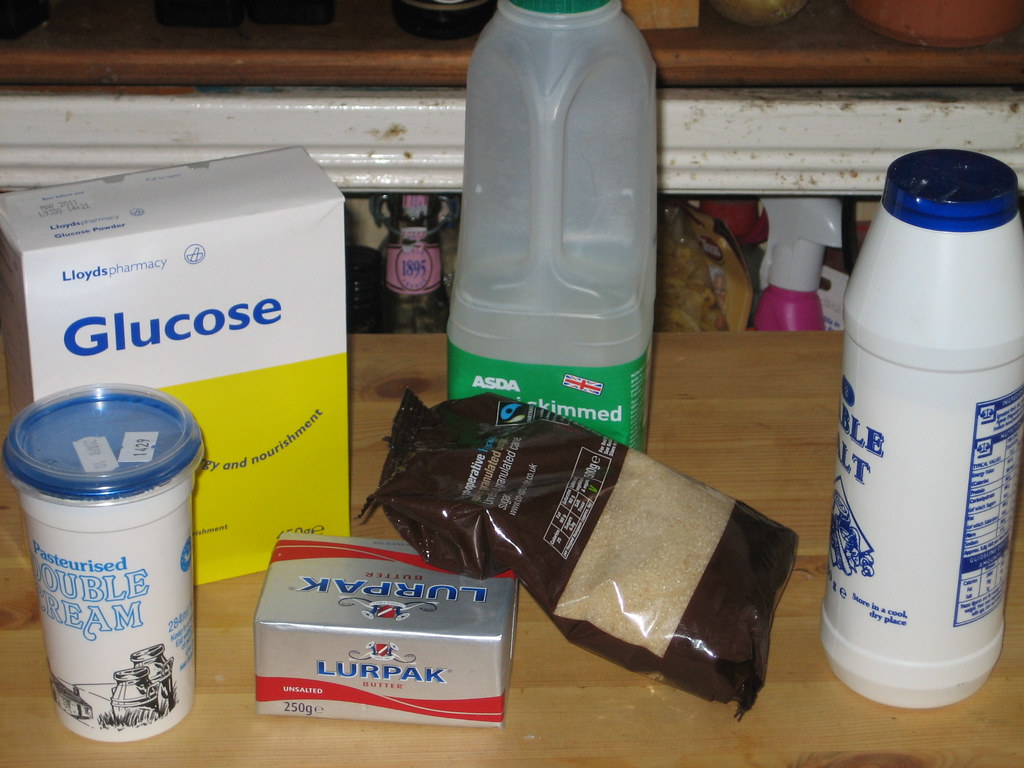
Whilst that's happening let's make a start on the caramel. The glucose is easy to get hold of, just go to your local pharmacy and they have it. You are going to end up with a pretty rich caramel. I had a little issue in that my thermometer only goes up to 130c & I needed a temperature of 147c so a bit of science got involved. unsurprisingly once the caramel is done (and stirring in the cream to the hot sugar mixture is one of those scary cookery procedures) that needs to go into the fridge too, this time its going to set.
That leaves the chocolate top. The recipe calls for 24hrs of sous-vide but a bit of reading suggested that this was to temper the chocolate, a bit of reading suggested some work with a digital thermometer would allow me to temper the chocolate reasonably well, so I got that all set up & ready.

The shortbread goes into a slow oven (gas 2) for 15 minutes, you've rolled it out pretty thin, so it doesn't take long. At this point I realized I had a lot more caramel & chocolate than shortbread, but never mind I had a plan.

The book calls for 1cm x 4cm slices, which I felt were a little small so we went with 4cm squares instead. The caramel is a bit of a bugger to work with, that could quite easily be me not getting it to the correct temperature or just my lack of skill with caramel.


That's the final assembled product. I had gold leaf, not powder so I scribbled gold onto the chocolate rather than gold coating the salt crystals. Once again hard work with a worthwhile outcome. 

The left over caramel got used with a more ordinary millionaires shortbread that we christened "public sector shortbread". I used a straight flour & butter shortbread & just spread the top with melted chocolate, which gives a very different mouth feel from the sharp snap of the tempered chocolate. We gave it a light gold scribble because as we all know the public sector isn't that rich


All jolly tasty and I''ll definitely give it another go when I've got a better thermometer and a smooth sided & bottomed pan for the caramel.

Wednesday, 24 February 2010

Snails

I like to eat snails, I enjoy their taste and texture, but I have to confess I do like the shock effect eating snails causes.

I was at a new Korean/Japanese restaurant last night. Firstly I've no idea why that combination was chosen, unless perhaps they thought we'd be frightened by just Korean food here in the bustling metropolis that is Nottingham.

I'm not going to review it because a) its a very new place & I'm not sure they've got all the bugs out yet and b) for various reasons (Including having to pay in cash unexpectedly I wasn't able to give the menu a thorough look. What we did have though was very nice, and I'll be going back if only for the Korean BBQ rice which was a lovely mix of Beef, sauce, steamed rice & pickles.

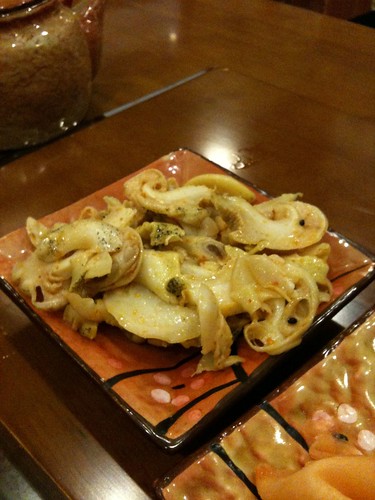
I've been trying to find out more about the snails as I wasn't convinced at the time they were land snails, the internet seems to suggest that they may actually be whelks. It tasted like a good chilli squid, with the same sort of bite but after 3/4 of a plateful the spicing got a bit much & my eyebrows broke out into a sweat.

Famous snails


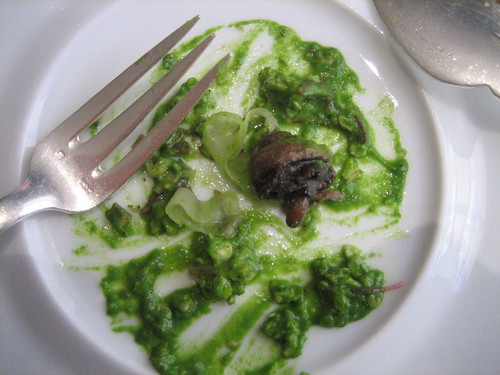
This is one of the most famous/infamous snail dishes available in the UK. Heston Blumenthal's Snail porridge. This is a phenomenal dish, full of great textures & rich earthy tastes. In fact it tasted so good I almost forgot to document it. The snails are slow roasted, and have a mushroomy earthy flavour, which is slightly unexpected (most of the time the taste of snail (here in Europe) is masked by garlic.


So yes I eat snails, and am quite happy to do so, from the humble escargot drowning in garlic butter to the dizzy heights of Michelin starred molecular gastronomy snails. The gastropod has it's place on the end of my fork.

Monday, 18 January 2010

Treacle tart a la Blumenthal

Probably the first thing you heard about Heston Blumenthal was "snail porridge" or "bacon & egg ice cream". They are both great dishes, but to the man in the street it seems more shock & awe than cooking. So a couple of years back when the BBC commissioned "In search of perfection" I tuned in. The first thing I saw was his treacle tart program. Him & his research chefs made a vast array of syrups, from scratch and then tasted them and came to the conclusion that "The one in the familiar green tin"1 was the best. That pretty much sealed my fate, after all how many 3 star chefs after experiment say buy the ingredient from the local co-op !

So when I got the book of the series I enjoyed reading it and started to look for a recipe I could give a reasonable go to, after the burgers the tart looked like a good bet, I was aware that some step would be given in an offhand manner, which to the home cook would take hair-pulling, teeth gnashing fury. I didn't expect it quite so early though. Here are the pastry ingredients.
 Yes that is a lot of butter & its about to cause me some grief & the most work of the entire recipe. The pastry is 400g of plain flour & 400g of unsalted butter (yup co-op's finest there). The recipe gliby says "you may have to add the butter in batches" The reality is you absolutely have to add the butter in batches, rubbing it in is going to take an hour or so, keep ice water to hand so you don't overwork the pastry. Once you got it down to bread crumbs you make it even richer with icing sugar, 2 yolks, 1 egg, the zest of a lemon and the seeds of a vanilla pod.

It seemed quite sticky at this stage, but prior to letting it rest in the fridge (for at least 3 hours, making my fingers thankful) I weighed it. 1.1 kg of pastry, and a vanilla & lemon scented kitchen. Good stuff. Only 2/3rds of this monstrous ball of pastry are going to be used according to the book, but that's not how it happened in my kitchen. The next issue was breadcrumbs, they are horrifically difficult to make by hand, in fact so difficult I had to go and cadge some food processor time off my neighbour. Back to the now rested pastry time to roll it out. The recipe tells you to do this between floured sheets of greaseproof paper which does make life a little easier, I'm sure I seen another TV chef credit Heston with this, but it seems a bit unlikely. Rolled out dropped into a buttered flan dish /tart plate (or in my kitchen 2 medium ones) and back to the fridge, this is some well rested laid back pastry. Half an hour later its back out the fridge, prick over the base, load up with greaseproof and baking beans (or whatever you use (HB suggests coins)) and take it back to the fridge for another rest. Time to pre-heat the oven. Once that's happened & the pastry has rested (30mins later) in go the tart cases to bake blind.

Lets have a look at the filling. Ok eggs & cream, then salt & vanilla. Quickly whip up a buerre noisette.strain & filter it and put it in a pan with your 2 tins of golden syrup (that's just under a kilo of refined sugar goodness ( A quick aside, treacle tart is even in its meanest incarnations a rich dish, if you are counting calories, don't make this)).
The heated syrup is a lot easier to work with than cold syrup.

This gets combined with the bread crumbs, some lemon zest & juice and the  egg & cream mixture. This then gets transferred to a jug to fill the tart case(s). There is a puzzling instruction at this point. "Fill the case with 2/3rds of the mixture transfer to the oven & then pour in the remaining mixture" The quicker witted amongst you will know why, I found out. Its so you don't slosh treacle mix everywhere. Time to relax while a nice slow oven works its magic on the treacle mix. An hour later and viola a treacle tart, or maybe 2. Having had little luck getting dry ice, I skipped the ice-cream, made a cocktail out of the egg whites & lemon juice and sat down with the neighbours (only fair since they lent me the food processor) and dug into still warm tart.
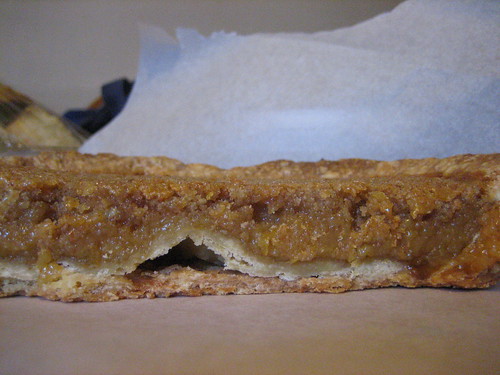

Oops, didn't quite get the pastry flat, but its vanilla/lemon scented goodness lifts the tart beyond the mundane, before you get anywhere near the filing. As you can see there is a crust over sticky goo, this is exactly how treacle tart should be. The top is on the edge of crunchy, and not dry in the slightest. Is it perfect ? Well with the burgers its very difficult to find a good burger in these parts, treacle tart however is easier, and I've eaten my fair share. From WI tart to corner bakery varieties, from cheap no frills to taste the difference. This is the best, everything about it is right, when I make it again, I'll be using slightly more chopped lemon zest, but that's about it. Oh yes the quantities, Heston does overshoot, and I can see several reasons why. The book says 8-10 portions. I'd say its more like 12 & then you can use the spare pastry & treacle mix to make individual tarts for deserving co workers.

To see more photos go here
The cocktail recipe will appear shortly
1 For those of you unfamiliar with the BBC they have to be quite careful about brand names, the tin in question is the familiar (to most of the UK)  green Tate & Lyle golden syrup tin. Yes that is a dead lion, and no those are bees not flies.

Monday, 16 November 2009

lemon meringue (with a perfect burger side)

Lemon meringue is one of my favourite desserts, I could rattle on about it for sometime (do remind me though to tell some stories about Paris).

I often watch Something for the weekend usually for recipes or cocktails, they don't have a huge hit rate as I have a peculiar palate, and they like to use feature ingredients, sometimes following trends I have no interest in. Vanilla Vodka gets a fair bit of use and generally I'm not a big fan, but its ubiquitous enough for me to make & keep a small batch of. On of Sunday's recipes included one of my favourite things Lemon curd. I've had a weakness for it for as long as I can remember, so when I saw a cocktail using it, it had to be tried

They called it A lemon butter sour but it tastes like a glass full of lemon meringue, so if you've the ingredients I give it a bash, I skipped the gomme as it was already sweet enough to my taste, but you might want to experiment with the lemon juice & lemon curd.

That was served as a prelude to a perfect burger tea in front of Dr Who with friends. Friends that had just returned from New York, so this was going to be a fair test. One thing I got wrong last time (& didn't quite fix this) was teh temprature of the skillet, it needs to be outrageously hot, I don't think you can have it too hot, so whilst my burgers took more like 6mins to get to 52 deg internally I reckon I can get the cooking time down to the recommended 4. So how did they fair ? Pretty well, being almost as good as the $15 empire burger, given that they were about $2 apeice I'm quite happy. (oh yes, they freeze very well indeed, just wrap them seperately)

Tuesday, 10 November 2009

Perfect Burgers ? (pt2)

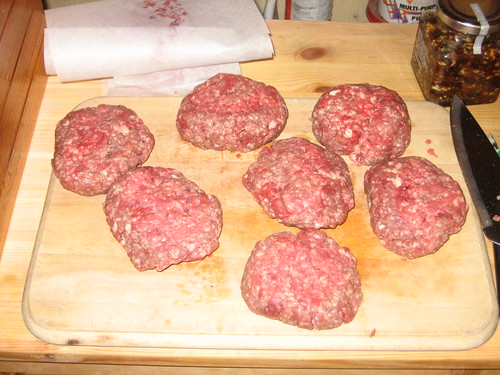
Time to take the logs of meat from the fridge & turn them into burgers. They ought to be approx the same diametre as the buns and about 2 fingers thick, the cold & the cling film combine to make this step a bit easier. then roughly shape them into burgers


There they are, if you have more burgers than people, wrap them in baking paper and then freeze them, they should be good for 3 months, but I doubt they'll get a chance to last that long.

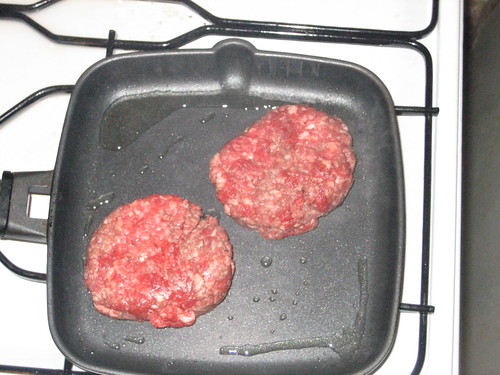
So to cook them, get a skillet very hot (5-10 mins on full heat) and oil it lightly.
Then put the burgers in.


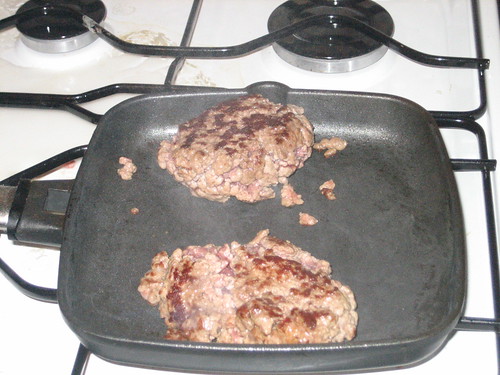
Now the instructions say turn every 30s, this allows a crust to form on the outside, but keeps the centre moist. I don't think I'd managed to get the pan hot enough, because after 2 mins they were more blue than rare/medium rare, so more flipping and more cooking.

Hot hot hot, flipping every 30s there is almost bound to be a casualty or two, in this case it was light flaking of the burgers.
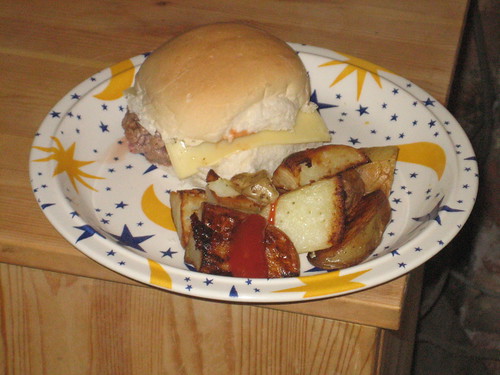
Since I'd skipped out on doing the whole job, I'd got some buns, cheese & Mr Hienz's ketchup. Instead of going to the chip-shop I made some wedges, the healthy alternative.


That's making me hungry to look at now.

So are they perfect burgers ?
I honestly don't know, they are very good, but this is the first time I've made burgers from scratch, and having traceable meat meant I could eat them much rarer than I would dare with store burgers.
The texture is very good, does aligning the mince make it so ? Probably.
Am I going to do it again ? well not for a while, I've still 10-12 burgers in the freezer, and they are reasonably expensive (Figure about £1:50 per burger, obviously it depends on the cost of the meat though, if you are going to do the whole thing, its going to be closer to £5 per burger.

Its shown me a couple of bugbears with the book, that I'm more prepared for now. Kitchen organization is an absolute must, because the odds are you are working in a family kitchen, complete with all the things competing for that space. Several of the recipes call for long processes, 6 hours in the fridge is nothing compared to making a pre-ferment 24hrs early (thats if you want to use the HB buns) or the amount of cooking the Chili uses, that said, its not exactly arduous and with a bit of experience I'm sure you can adapt the recipes to be even more usable in an average home.

I don't know if the burgers are served at the "hinds head" in bray, but I'd not be suprised to see them on the menu at around £15 which doesn't seem that unreasonable, especially if they come with triple cooked chips.

I did notice the mincer has a sausage nozzle, the book has a bangers & mash recipe and it appears that Heston & I share a taste in sausages (Pork, a little spicing, no herbs or that kind of nonsense) so I could try that next.

Perfect Burgers ? (pt1)

At some point I made a rash comment I was going to make something  out of one of Heston Blumenthal's cookbooks. A chance encounter with a cut price mincer lead me to his Hamburger recipe. The full thing which includes making buns & cheese slices is a somewhat daunting 30+ hour oddesy. So I chickened out and went for just the burgers, the theory being that when I come to do a full recipe I'll have an idea of the pitfalls.

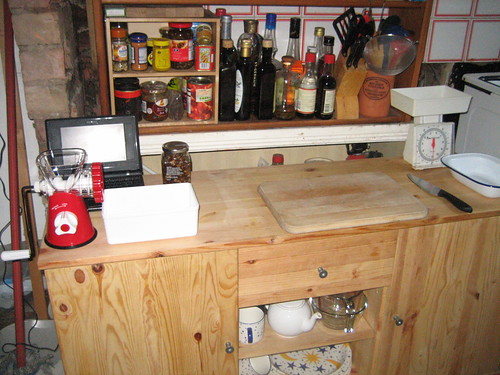
First set up a workspace, its probably not going to be big enough, because its very unlikely you are a michelin starred chef , even if the perfection recipes are meant for the home cook (A slightly nerdy obsessive one at that).


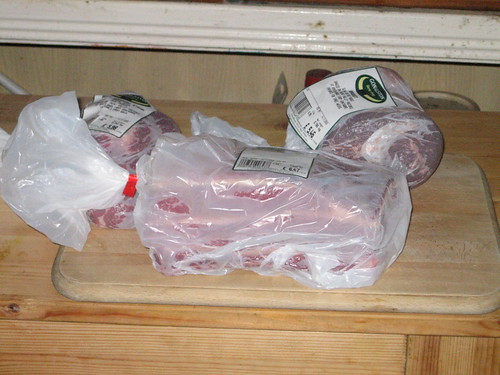
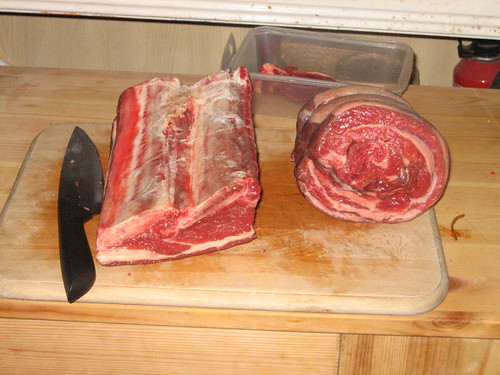
There we go, ahh the folly of youth. Then meat, specifically beef,more specifically 625g chuck, 625g brisket, 1.2kg short rib.


Short rib is a bit of an odd cut, after much discussion with 3 butchers (including a South African (I mention it as they really seem to know meat))
flat rib was suggested as the correct cut.

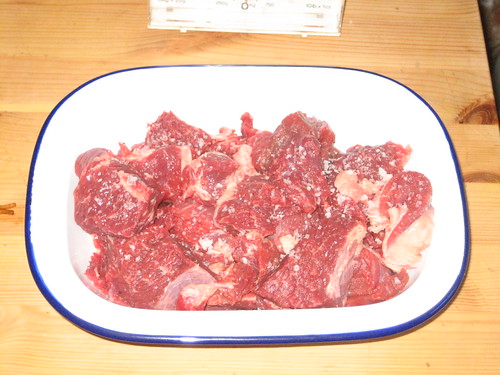
First off dice the chuck and then put it in a dish with some salt (a teaspoon full ) and then let it sit in the fridge so the salt can draw out the juices.


Looks good, but no time to admire it as there are 2 more cuts to dice


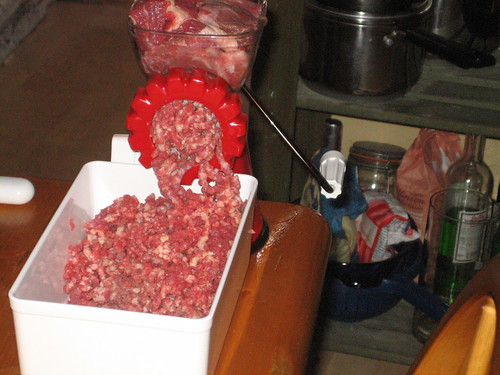
And then mince, not once, but twice, through a reasonably fine mincer too. My mincer is a hand crank one, this is going to give me lats that some would kill for.


 Lots of mincing happens, fortunately I'm getting 4-5 hours rest whilst the chuck & salt do their thing, unfortunately this meant I was getting rest from the kitchen, there were other chores to do.

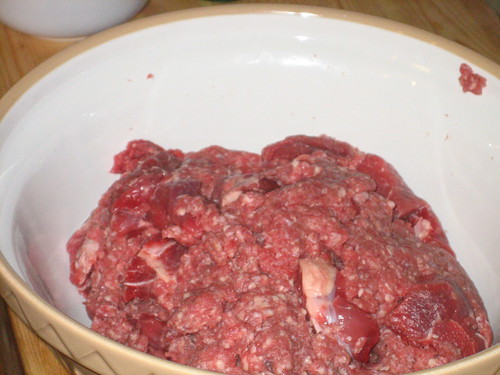
 Now I've got a bowl of twice minced beef & a bowl of unminced chuck, that all needs mixing together, this is almost the home straight.


Or so you'd think, however this next mincing has an attention to detail that is a hallmark of molecular gastronomy. Several tests Had Heston thinking about the texture of his burger, he solved it by putting the final mince through a coarse plate, and most importantly keeping the mince aligned as it came out.
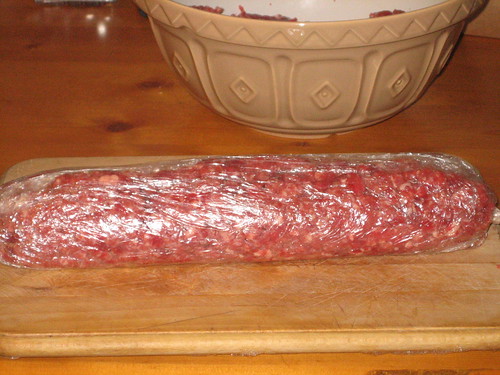
The stage is a bit awkward, even with an extra pair of hands. It should be coming out on to cling film, then you can wrap it into a beef log.


You can probably see meat in the bowl behind the log, there was no way the entire amount could go in one log & the fridge, so I separated the mass into two. Logs safely rolled it was time for more chilling. The vaguries of the weekend meant that the actual cooking would be the next day.