Showing posts with label Techniques. Show all posts

Wednesday, 7 March 2012

Clearly irresponsible


I was invited to compete in a Havana club rum competition, I originally got the wrong rum, thinking we were using the 5 or 7 yr old gold rums not the 3yr old, that shaped my idea for the drink. As a result of that & the article on agar clarification I'd read  and some pouring over Embury I decided to go with a new variation on the Hemingway Daiquiri. 

The first job was to get & taste Havana club 3yr old. Its a white rum, but aged in oak barrels, giving it depth and a very pale straw colour, a great cocktailing rum really. Then it was time to try the gel clarification. The first test gave glorious results as a thin stream of pale yellow juice ran & dripped from the muslin. For some reason though the clarified grapefruit & lime didn't play well together. Using cordial instead of juice for the lime fixed the problem, which meant the daiquiri was a bit less Hemingway, but seriously how much of that diabetes was due to the great man's rum habits ? I now had a working recipe so it was time to clarify more grapefruit ready for the actual competition. 

Disaster this came out less than crystal clear (not a technique problem, just a hiccup in the process). A bit of filtration took care of that (after a tense couple of hours where I worried enough juice would make it through the filter). Daiquiris are normally shaken to get them good and cold, that wasn't going to work here, so a bit of mucking about with an instant freeze pack allowed me to chill my rum and away we went 

I was up against some seriously stiff competition, so I'm reasonably happy not to win and it was a great night of mixology & rum, so here is my take on the Hemingway daiquiri,

The clearly irresponsible 

60ml Havana club 3yr old rum (another white rum will work, but won't be as good)
20ml Clarified Grapefruit juice 
15ml Maraschino liqueur
10ml Lime cordial (I use Roses' see debates about the Gimlet)

Stir over ice, double strain (Hemingway was particular about ice in his drinks) and garnish with a grapefruit twist.

Here it is with an ordinary Hemingway for comparison purposes.(Hemingway left, Clearly right)


Saturday, 25 December 2010

Mulled cider

Traditionally cider is mulled by plunging a redhot poker into the mug. So why not ? Well it turns out I don't have quite the right shape of poker, we can work round that though.

You'll need mulling spices:- Nutmeg,Ginger,Cloves,Cinnamon,Allspice & maybe a little Star Anise. Adjust them to your taste and put them in half a pint of good (hard) cider. A couple of spoonfuls of dark sugar, a measure of rum (or maybe brandy) and some citrus (hey it's Christmas so use some tangerine segments). Stir it well together and pour into a fireproof mug, then plunge in a redhot poker.
The cider will foam up, with a great hissing sound and the room should fill with the scent of christmasy loveliness.

If you aren't blessed with a real fire, then heat the mixture through gently on the stove till warm & then pour out.

Monday, 20 December 2010

Poached duck eggs

I do like poached duck eggs, I finally got enough time together to have a stab at doing them sat bains style
First off I needed a water bath, this is my ersatz set up.

Thats a large pan of water, my meat thermometer and the smallest ring on my gas hob on it's lowest setting heating maybe a third of the pan's base. This kept everything at a fairly even 58-60c.

The eggs went in & I spent the next couple of hours stopping the water from heating too much or cooling down excessively. In between worrying about that I fretted about how I was going to get the eggs out of their shells (Yup you poach them in the shell, I assume it doesn't count as boiling, because you get nowhere near 100c). Turns out they come out of the shell quite easily if you can bring yourself to give the shell enough of a tap against the pan edge.

I served them on hot buttered toast, because it was a "quick" lunch rather than anything fancy & because I was all out of pata-negra ham.

Was it worth it ? I think so, with a proper water bath it's definitely worth while, the yolk ends up really rich. I think next time (and there will be a next time)  I'll let them go for a bit longer and I'll keep the temperature more to the higher end.

Enjoy, I know I did.

Sunday, 19 September 2010

Restaurant Sat Bains

Nottingham's only Michelin starred restaurant, Sat is also a molecular chef, so some comparisons with the Fat Duck are inevitable, so I'll deal with the 2 biggies straight off. Sat's menu is a lot more local & seasonal, he also is a bit less multi-sensory/theatrical than Heston. We'd got a package offer, so a
room, champagne on arrival and the 7 course tasting menu. The wine list is huge and roams from pretty reasonable (25-30) to stratospheric. Having had the paired wines at the Fat Duck we did the same here. First up was an amuse bouche from the kitchen of an oyster foam with a pigs head croquette and a smoked haddock one, both were really good. Next was Sat's signature dish of ham, egg & peas. If you don't know this is the only dish that scored a perfect 30 in the great British menu and consists of a slow poached duck egg, peas, pea & mint sorbet and pata negra ham. I've eaten a fair few poached duck eggs, this was glorious. The sorbet tastes incredibly fresh & green and provides a great contrast to the warm duck egg.
Then it was onto the menu proper and an Alsatian white that we ended up killing, that was for the starters and went incredibly with the first, Pork, pears, chicory & monkfish which came with a liquorice sauce. The pork was superbly cooked and the pears which ranged from raw to a pear gel really went with it, the monkfish & liquorice were good together, but might not have needed to be on the same plate as the pork. Next up was Organic salmon with coriander.This was a cube of raw salmon, incredible pickled vegetables where placed on top and covered in an oyster & coriander emulsion. Brilliant, absolutely brilliant. 
Next came NG7 2AS, an enigmatically named dish, that turns out to be foraged from with in a mile of the kitchen. If you get to eat it, it probably won't be the same as this. A salad of mainly sorrels with pickled elderberries, textures of crab apple, hazelnuts and a hazelnut  sand. With a glorious horseradish croquette.


For me this was the stand out dish, and it took a while to eat as everything needed to eaten on its own and then in combination.
The "main course" turned up, Yorkshire grouse with blackberries and a home made faggot, paired with a premier cru Burgundy. If the dish was any bigger then it would have been instant gout. Lovely meaty flavours from the (very) rare grouse breast and the beef faggot, complemented incredibly by the deep blackberry sauce and matched to the kind of wine that makes you understand where Jilly Goulden & co are coming from.
Then came "Crossover" a bridge between the main course & dessert. Its a mix of ham, pineapple, maple syrup and Parmesan cheese. Sounds odd but really works. 
The first of the desserts was simply titled "Chocolate" and was a rich chocolate mousse with a thyme & salt caramel and a buttermilk ice cream paired with an Australian muscadet, another standout bit of wine matching. Again well chosen complementary flavours the acidity of the buttermilk cutting through the rich sweetness on the plate, the addition of thyme to caramel provided a pleasant je ne sais quois and is something I think I might give a bit of a try in future.
The final menu course was "Raspberry" which consisted of a dish containing various raspberry things (a granita, a gel, whole berries) dotted with hazelnut meringues, both hard and soft and a lolly of freeze dried raspberries a white chocolate shell and a beetroot ice cream. 


Beetroot is much loved by the modern/molecular chef as it has a very interesting trick, where its flavour can be flipped between sweet & savoury depending on what it's served with(*). If you know that you can play with it in this dessert. This was teamed with a Sauternes which was probably the most disappointing wine of the night, in so much as it was merely very good, compared with the excellents of the other wines. Finally the richest chocolate brownie I've ever eaten arrived on a small square slate. I managed half of it.
So go, it's highly recommended, staying over in one of the fairly luxurious rooms takes a bit of a sting out of the bill, but you are paying toward the top end of 1 star prices. That said I don't think it can be too long before a second star arrives. The dishes are innovative and very well made, the wines well chosen and the service spot on. There is a 12.5% service charge on the food bill, which is  reasonable at this level.

(*) A high degree of acidity flips the beetroot from beetrooty to blackcurranty. Eating the raspberry chocolate shell to expose the ice cream with in (as shown in the photo) allows you to taste the beetroot ice cream in its vegetable guise. Dipping it into the granita turns it fruity again. 

Monday, 13 September 2010

Lavender Old Fashioned

This came up in MixMO as an entry from Backyard Bartender which intrigued me, especially as I still have lavender flowers.

I had a read of the recipe & thought since I'd give it a go. Then I had a read of The Fine Art of Mixing Drinks and decided to stick to a more standard old-fashioned. I'd used up all my Gomme making Jellies so I had to do it the hard way

First put 1//2 a barspoon of sugar in the bottom of your glass add 2 dashes of bitters an Ice cube & a lavender flower head. Stir gently to start dissolving the sugar. After a couple of minutes add 5ml of St Germain (Elderflower liqueur). Keep stirring gently, you want to dissolve the sugar but not break up the lavender. Add 10ml of bourbon and keep stirring. Once all the sugar has dissolved (5-10 minutes) add 35ml of bourbon and a second ice cube, stir for another 10-15 seconds and then enjoy.

You should end up with a very well balanced drink in which the lavender & elderflower florals combine and act quite nicely with the bourbon, giving a smooth drink with a bright aftertaste. It is always a bit of hassle to make an old fashioned from scratch, but this one is worth a go.

Wednesday, 28 July 2010

Pizza !

Over at lifehacker they're pretty serious about pizza. Pizza is pretty nice, I can get one delivered with little more effort than opening a new tab on my browser, so what's the fuss about ?

Homemade pizzas
Turns out pizza is one of those things worth the hassle. Heston Blumenthal goes into his usual depth when he makes pizza in "Perfection" Kilos of tomatoes get used, dough is prefermented and so on. The main thing he talks about though is the temperature at which the pizza gets cooked. Wood fired pizza ovens are really hot, hotter than you can get out of a domestic oven. Fortunately there are some simple solutions to get you started.

First, dough. My pizzas were made with a simple flour,water,yeast and salt dough. It takes about 10 minutes & doesn't need to prove though letting it rest always helps. Toppings, cheese & tomato are glutamate rich, so a well made pizza should have a strong umami flavour. To get my tomato sauce I butchered a ketchup recipe leaving out the sugar & the final reduction and fiddling with the seasoning (Basically I left out the spices & added more herbs). Takes about an hour, though most of that is the sauce bubbling away on its own. The 2 pizza halves up top are potato & prosciutto (top) and Salami & mushroom (bottom). To cook them I used the skillet method, heat a cast iron pan on full heat for about 20 minutes, meanwhile get the grill going at full heat.
Slip the prepared pizza onto the bottom of the skillet(*) and whiz everything under the grill, 2 minutes later you have pizza. Really good pizza, OK it takes more than opening a tab on your browser (I had to do that to get the dough recipe) but the taste is worth it.

(*) Sounds simple, it's not. You are going to be wrestling with a floppy circle of dough, loaded with sauce,cheese & toppings and a ferociously hot pan. Get help, make sure you've got tools and take care. 

Monday, 7 June 2010

Newspaper trout

This isn't so much a recipe, more of a method for cooking trout. I was told about it by a fellow fishing from a bridge over the river Slaney. The fact he was fishing from the bridge & a story he told me about phoning fish(*) lead me to believe he was actually a poacher. Mind you since he had a bag of fresh river trout and this is a simple goto method for cooking trout, I'm happy to over look it.

You'll need some trout, 1 medium trout per person is the right amount in my kitchen, you might like to go for a larger trout & share between 2. Several sheets of newspaper, 1 sheet of broadsheet or 2 of tabloid is about right per fish. Seasonings e.g. salt,pepper, parsley or other fresh herbs. Gut (or get the fishmonger to) the trout and wash out the cavity, then stuff it with what ever you fancy (I'm using a little butter & a couple of lemon wedges).
Wrap the trout to make a nice parcel and then soak it through. Do this after wrapping the trout, doing it before will just leave you in a mess of papier mâché.

Then it goes under the grill, onto the BBQ or into a hot oven (gas 6 or equivalent). If you aren't using the oven you'll need to flip the parcels half way through the cooking (so after 5-8 mins). Once the paper is dry (and beginning to singe) the fish is cooked. This is where this method scores highly, as you unwrap, you'll find the skin sticks to the paper. The flesh should just come away from the bones, with a bit of patience/practice you can remove the fillets intact, usually at this point I'm too eager to get eating. That's all there is too it, perfectly cooked trout time & time again.
The Salad leaves on the right are the first produce from my micro salad garden (which unfortunately got devastated by the rain that started hammering down about an hour after I'd finished eating). Give this method for cooking trout a go, its easy & the results are very tasty.

(*) The fact he was fishing from the bridge, gives a clue that he wasn't entirely on the level, due to the very weird laws we have in England & Ireland about river ownership. By fishing from the bridge he wasn't trespassing, though he probably had no right to the fish. Phoning fish is definitely dodgy, but this act was carried out by a "friend" of his. An army surplus field telephone, a boat & a net are required. You drop the wire from the phone into the water over the side of your boat and crank like mad. The resulting current stuns the surrounding fish and you scoop them out with your net.

Sunday, 11 April 2010

The well tempered gourmand

Oh dear a punning title and warning of a glut of edits.

Anyway this is about chocolate. Hard as it maybe to believe chocolate is pretty complicated stuff, it exists in 6 different crystal forms. The one we really want is the Î˛ crystal and to get that we have to temper the chocolate.
Normally chocolate already comes in this form, by melting it we mess that up, this is where tempering comes in. The old fashioned method involves heating the chocolate till its fully melted and up around a temperature of 41c. Then removing 3/4 and working that on a cool marble slab down to 28c then adding that to the remaining 1/4 and bringing it to a temperature of 31c.
However we can take advantage of a bit of science and do this in a slightly easier way, using seed crystals. Since our chocolate is already tempered,we can reserve a bit and use its crystals to get the melted chocolate to behave. A bit of reading suggests about 10% is enough. So put the remaining 90% in your double boiler and melt it, stirring to bring the whole lot to a uniform temperature of 41c. Take it off the heat, and drop in the reserved chocolate, stir till the whole lot is at 32c, the chocolate ought to be tempered. Its then time to use the chocolate, of course if it goes above 32c you'll have to temper again.

You should end up with a glossy chocolate that snaps very definitely. It is a bit of fuss, but it does provide a much better chocolate for some applications.

Tuesday, 23 February 2010

Cocktailing for beginners Pt III:- Sweet Vermouth

I know it's vermouth again, but bear with me a little. We'll also have a little look at shaking & shakers. Generally speaking French vermouth is dry, whilst Italian is sweet. Red vermouth is generally the sweetest & adds a pretty good colour to a drink. A 50/50 mix of dry & sweet vermouth used in a spirit & vermouth cocktail is generally referred to as "perfect", ask a good bartender for a perfect Martini & that's what you'll get. Its a good idea to keep both in your cabinet.

The shaker is the iconic cocktail tool, there are two main types, the boston, which consists of a glass & a tin that fit together and are held in place by the contraction of the tin, and the Cobbler which is all metal. You are probably thinking of a Cobbler shaker at this point, which comes in 3 parts. A tin, a strainer and a cap. You fill the tin with ice & ingredients which can often be measured using the cap, fit the strainer, fit the cap, shake hard remove the cap & pour. These kind of shakers can be had quite cheaply, you ought to be able to pick up a reasonably nice one for £5-10 from a second hand shop or on line. Of course you can spend more and get silver or designer or antique, its up to you.

Fibber McGee

 Given we have sweet vermouth & a cocktail shaker (improvise with a container with a well fitted lid) let's put them to use.

3 parts Gin
1 part sweet vermouth
1 part Grapefruit juice
1-2 dashes bitters

fill the tin of your shaker with ice, and then add the ingredients. I like to use pink grapefruit juice as it's slightly sweeter, but thats a personal preference. If you are using fresh squeezed juice you might want a finer strainer on had to catch stray pips & pulp. Fit the strainer & cap, check its a tight fit. With the top aimed over your shoulder, shake hard for 10-15 seconds. The tin should get very cold. Set it down remove the cap & pour.
Enjoy your drink, you've earnt it.

Next time we'll look at a different base spirit to gin and another classic cocktail.

Wednesday, 17 February 2010

Pancakes

Yesterday was shrove Tuesday or as it's better known in these parts pancake day (not Mardi Gras, we don't do that kind of thing). So time to get pancaking.

I'm not talking about US style buttermilk pancakes, nor am I talking about crĂŞpes, the closest none English equivalent is the Dutch pancake, except they cook the filling into the batter.

This is one in the frying pan. To make them you need a thinnish batter, I base mine on 2 eggs & 500ml of whole milk with enough flour (self raising) to make a batter that drips. Some people add a little melted butter, some use less egg and some water instead of all milk, that is as far as I'm concerned a bit on the stingy side. We were taught in school that the pancake (and its traditional sugar & lemon "filling") was made to use up ingredients that were forbidden during lent, so there is no need to hold on to spare eggs, milk, cream or butter. The batter should be allowed to stand, 30 minutes is a minimum, at home pancake batter was made in the morning & pancakes eaten in the evening. The batter goes into a hot frying pan, here we meet the first cooking ritual. A bare amount of fat goes into the pan over a high heat and it's then carefully watched for the blue haze. Once this elusive wisp of smoke is seen in goes some batter. Enough to cover the bottom of the pan to a depth of about 5mm (any more is a bit too thick, much less is stingy). Once the top of the pancake is set you get to turn the pancake over.

Tosser or Flipper ?
 As you can see I'm a tosser (it took several attempts to get this shot, so I'd taken to pulling faces to amuse myself).
Which is the traditional way to turn a pancake over. There is a whole host of peripheral stuff associated with the pancake toss. Its a staple of slapstick (they stick to the ceiling and fall down at the most hilarious moment) and several folk rituals, usually races. Science tells us that the best toss comes when the pancake has slithered to the far side of the pan, experience tells us that a crisp wrist action is better than power from the fore-arm. If this sounds like hassle & a potential waste of good food, flipping is the answer, just slide a spatula or fish slice under the pancake and turn it over in the pan, we won't think any less of you, but you'll be missing out.

After a couple of minutes the underside should be done, slide the pancake out onto a warm plate, sprinkle with sugar and squeeze lemon juice over, roll up slice & eat (The chef usually gets to eat whole as they are a pancake production line). If you can get everyone in the kitchen & dole out hot pancakes to them so much the better, there is no really satisfactory way to keep them warm. The "filling" is traditionally lemon & sugar as described, some people go with jam, others with syrup (either golden or maple) but generally on pancake day the filling is sweet.

Here is another interesting take on the English pancake day experience

Tuesday, 16 February 2010

Cocktailing for beginners Pt 2:- Bitters

One of the first things that throws beginning Cocktailers strolling through a shiny new cocktail book is bitters. What are they, Where do they come from & who the hell has any.

What bitters are.
Primarily a vegetable tincture or Elixir, with no added sugars. They tend to be very alcoholic ranging from 40-80% abv. Unsurprisingly they are bitter in flavour. They belong to the class of ingredients described as aromatic, imparting a bitter, spicy or herbal flavour. They come in a range, most bottlers making their own formulation. The good news is unless you are making very specific high end cocktails they are reasonably interchangeable. The exceptions being fruit or vegetable bitters eg: orange bitters,celery bitters, and so on.

So where do they come from ?
Usually the ingredients are tropical, with Quinoa bark (a source of quinine) being quite common. Rather than roaming about for a bunch of barks & herbs though Angostura bitters are found in most UK supermarkets (occasionally on the baking aisle as they make a good addition to various cakes). They aren't expensive and a bottle will last you quite some time. Otherwise its the internet. ( The bitter truth have a good selection).

Who has any ?
Pretty much anyone who makes cocktails, especially if they are making the older classics (A lot of 80's cocktails do away with bitters completely). You can often see a battered bottle of Angostura hiding on back shelves in ordinary bars.

That's enough about bitters lets get down to making drinks.
Pink Gin
(Sorry its not a good photograph)
Pink gin, like a Martini is quite simple but you can spend ages fiddling about with it. Some people use the bitters as a rinse, and decide to either chuck any remaining out afterwards or leave it in, like an extra dry Martini.

We'll stick with a reasonably simple recipe though. Fill your mixing vessel with ice. give it a couple of dashes of bitters (its just like shaking out sauce or vinegar, but go easy we only want a couple of dashes for now) per person. Then add a glass of gin per person. Stir for 20-30 seconds. Strain the drink into serving glasses making sure the ice stays behind. You should now have a pale pinky-maroon drink. It won't taste like gin, and it won't be so bitter you end up pulling faces when you taste it (If it does, you've been a trifle heavy handed with the bitters). Once again when you've got a bit of a feel for it experiment. Here's a quick description of rinsing.

Put a drop or 2 of bitters in the bottom of your glass, swirl it, the idea is to get a film of bitters all over the glass. You can normally manage this and have bitters left over in the bottom. You can pour that drop away or leave it be, its up to personal taste (left in you have a Pink Gin "innie" poured off you have a Pink Gin "outtie") Then fill the glass with cold gin or cold lemonade (this makes a Campbell, not a bad non-alcoholic drink(*)).

We'll be adding another ingredient next week, but it'll be a bit more simple than bitters (the drink however will probably be more complex than the 2 we've made so far)

(*) If you are strictly tea-total, there is a minute percentage of Alcohol, but its diluted way down by the lemonade.

Tuesday, 2 February 2010

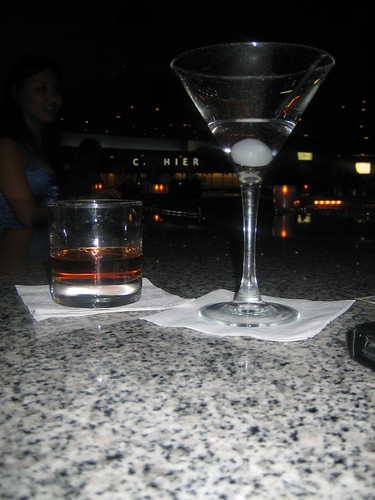
A dry Gibson

I'm not a fan of olives, so I like my Martinis with a twist, I also Like them dry,very dry, so dry I'l need a drink afterwards. I've experimented with rinsing, with drier vermouths (Noilly Prat gets a lot of use, being dry & easy to obtain),misters, and homoeopathic techniques. I'm now a bit more sensible, but I still want my Martini to be dry (and vodka free).

Early on in my cocktail experience I found the Gibson, in which the olives are swapped out in favour of tiny pickled silverskin onions. It was some kind of nirvana and its a handy thing to order if you are unsure of the ability of the bar-staff.

Those of you who poke about in EXIF info will find out that this picture was taken on Xmas day 2008. I'd gone to Las Vegas for xmas & was determined to enjoy a few cocktails. Unfortunately I met with a lot of disappointments. We went to Wynn and got ourselves a grand table on the terrace. Unfortunately my Gibson was less than grand, merely OK (I make better at home).

Waiting around in the Hotel (the Luxor) I wandered up to the main bar (liquidity) and sat down to order a coke. The bartenders were mainly chatting & milling about and one asked me why I was drinking coke. Normally I'd give a bit of a snappy answer, what I drink is my choice. This time though I had a bit of time & was pretty relaxed so I started to discuss my cocktail experiences. The bar guy told me "I make seriously good Martinis",
"yeah you & every other bartender in this town",
"OK here's what we'll do, I'll make you, your Martini of choice. You don't like it you don't pay, you do like it you tell everyone"
"fair enough, one terribly dry gin Gibson please"

He went away rattling through the bottles of gin, vermouth, and collected up his tools. A mixing glass full of Ice went on the bar in front of me, and the Martini was stirred up there & then. Once it was done the bar (a couple more staff & a friend had joined in my now) fell quiet, punctuated of course by the quarter rattle of a large casino. I took a sip.

"so how much is a dry Gibson then ?"
"$10"
I put $20 down and spent a seriously happy 20mins chatting with the staff & my friends (the rest of the party turned up) drinking a Serious Martini.

Like the sound of it ? Gibson my way.

20 parts GOOD London gin (Tanqueray, Bombay sapphire, or the like)
1   part Dry vermouth
3 small silver cocktail onions
Lots of ice

Shovel enough ice into a Martini glass to give it a heaped fill, pour in water to help chill, Fill you mixing glass with ice, pour in a splash of Vermouth, stir it all round and drain the vermouth, put in your measure of Vermouth, and then add the gin, stir for 20-30s dump the ice out of the glass & quickly dry up any remaining water. Pour Martini into glass. On a cocktail stick skewer your 3 onions(*) stir the drink with them a couple of times & then serve.

(*)3 is the ideal number, I only have empirical evidence for this, so if you are after a good Gibson stick with3, if you are experimenting, good luck and take care.

Monday, 28 September 2009

Inspiration is odd like that

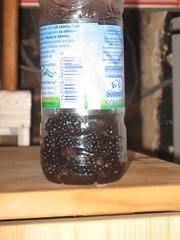
I had an altercation with a bramble bush on sunday morning, I decided to take revenge by grabbing all the blackberries.


The water bottle was the only container I had with me but the blackberries (from a random sampling you understand) were very sweet & needed to be claimed. Fairness demanded it. So what was I going to do with them, there weren't enough for pie or crumble. Then it dawned on me, time to make a spin on the classic Bloodhound (if you don't fancy the link its a perfect martini with strawberries). Get the black berries into your mixer with "some" gin.


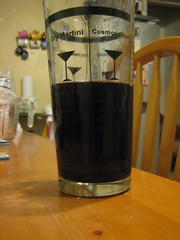
The depth of colour is due to the rough ride that the blcakberries had on the way home. Muddle (I'll go into detail about muddling later) add the 2 vermouths and the ice, shake hard. You are going to need both the hawthorne strainer and a fine strainer to get this in to the glass (as a lot of the blackberry pulp is very fine you'll probablay have to "encourage" it with a bar spoon).


Its a bit drier than a Bloodhound (natrually) but its a great taste & a stunning looking drink (a shame the photo doesn't do it justice, but I wanted to get on and drink it rather than document). Unfortunately Blackberry season is coming to an end. You could always swap in a blackberry liquer or if the DIY mood is on you make blackberry gin.