Another mention of that restaurant.
A couple of things left me with very strong taste memories, the first was the Douglas fir sherbet. I was out mountain biking a couple of months after eating at the fat duck & passed through a Douglas fir stand, instant hunger.
The second was tea jelly, I was reminded of it whilst doing research for the shortbread, since the chocolate wine was a definite no-go maybe the tea jelly would be good ? I wasn't holding out much hope due to the presence of exotic gelling agents in HB's cookery. Fortunately this used good old Gelatin. Malic acid was the weird ingredient, but its easy to get at homebrew shops.
The book is very precise about the water used, it needs to have a calcium level of 100-400ppm. I had a slight factor of 10 issue when converting to milligrams so ended up with a water having 36ppm of calcium (this may be important later).
It also needs 3 different types of tea, calling for earl grey, Darjeeling & green. I've got a fairly good idea about tea, so I used my favourite smoked earl grey and swapped the Darjeeling for a maloom and used a gunpowder green for the green tea .
Anyway you make a syrup of 2 kinds of sugar & then cool it to 4c. Then the lemon juice, malic acid and teas go in to infuse for a couple of hours, which you then strain to clear (I used 2 strainers, you can use a muslin if you want it really clear). Add the leaf gelatine to the mixture and heat gently till it's dissolved and refrigerate till it sets.
I'd not left myself a lot of time, and it didn't seem to be setting, so I panicked and put it in the freezer, all the while trying to work out if I had got my factors of 10 confused. I served it (more than a little dispiritedly) as a failed tea ice. The taste was pretty much spot on (I'm ridiculously happy about this as its a taste I really enjoyed and I can make it whenever I want) and it had started to gel so maybe my failure was time based ?
I've found a water with the correct calcium ratio, so I'll be having another attempt and I'll leave myself some more time.
Note for Americans, jelly in this case is similar to jello, not a preserve for spreading on bread.
An occasional journal of food & drink, mostly the stuff I've made myself. There will of course be lots of cocktails
Showing posts with label Tea. Show all posts
Monday, 12 April 2010
Saturday, 30 January 2010
Smoked out
Following on from my MxMo experiments I found this post, being fond of Islays it gave me an idea. Hanging round in the globe o' booze there was the remnants of a half bottle of Caol ila. Infusing Lapsang into the whisky required a bit of tasting and tweaking. The result somehow flatten the iodine note from the ila & the astringency from the lapsang's pine smoke.
I took a sample to my favourite bar and we tried out a few ideas.
We used the whisky as a base, and then used some port to balance out the tannins, a bit of cherry syrup to balance the acidity and a splash of sweet vermouth to round out the body.
Up front was a smooth sweetness, the body was warm & round, but the entire drink was all about the finish, which was a massive blast of smoke. Smooth, sweet, fragrant smoke. Possibly this a one trick pony of a drink, but a whole bunch of ideas got discussed, and since there is more left, I think I'll try and put some of the ideas into practice.
I took a sample to my favourite bar and we tried out a few ideas.
We used the whisky as a base, and then used some port to balance out the tannins, a bit of cherry syrup to balance the acidity and a splash of sweet vermouth to round out the body.
Up front was a smooth sweetness, the body was warm & round, but the entire drink was all about the finish, which was a massive blast of smoke. Smooth, sweet, fragrant smoke. Possibly this a one trick pony of a drink, but a whole bunch of ideas got discussed, and since there is more left, I think I'll try and put some of the ideas into practice.
Monday, 25 January 2010
Crumpets v Pikelets take two
The last lot of Crumpets using the Hairy Biker recipe where good, they just weren't good enough. The purpose of crumpets (and pikelets) is to form a toasty matrix for holding molten butter. It turns out that Hugh Fearnley-Whittingstall has a recipe (well more a sermon on tea-time treats). I thought I'd give it a whirl.
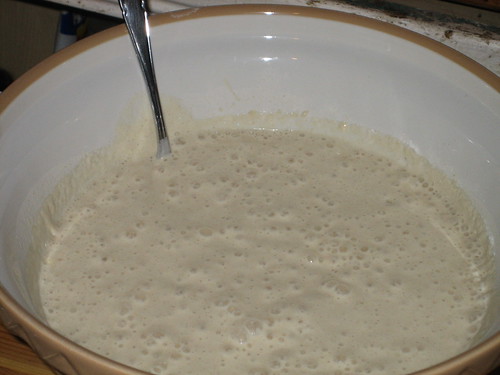
Thats the batter there, after the yeast has done it's work. The batter is a lot thinner this time round, more the texture of thin cream than the doughier batter of the Hairy recipe. Time to heat the skillet and find out what goes on. Hugh Suggests a test crumpet, which by tradition wil be sacrificed to Chef's privilege so I'm all in favour.
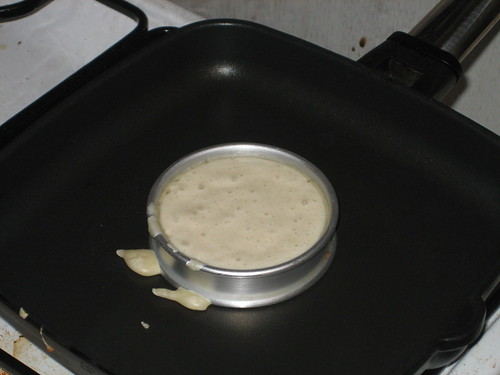
I was a touch sloppy getting all the batter into the crumpet ring, but the 2 important points are on display, 1 bubbles, and bubbles make holes, which is why we are making crumpets in the first place. 2 the batter is staying in the ring, its not oozing out of the bottom, so we've got the correct proportions. What follows is about an hour with the skillet & crumpet rings, but Hugh insists that pikelets are just flat crumpets (a position I've opposed for a long time, but since I've failed to find any evidence to back up my stance, I'm reluctantly agreeing with Hugh & others). This does though mean that I can get a nice system running where I alternate between crumpets & pikelets & get to clean the crumpet rings without wasting gas.
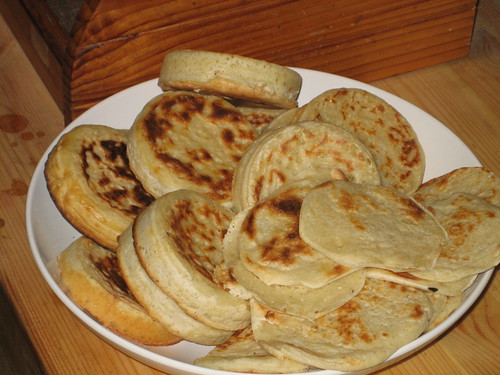
Well here they are pikelets, the store bought ones of my youth were actually a bit more circular & a little less rustic than these. Even so there is a good deal of promise being shown. At this point, if you've never enjoyed crumpets or pikelets you are probably asking yourself "Why is he so worked up about this ?". Well, pikelets have a different mouth feel to crumpets (in my opinion a superior one) that these experiments lead me to believe is due to their thickness. In both its possible for a hole to extend through the entire depth, of course with crumpets being several centimetres high, its unlikely, pikelets however are more in the order of millimetres thick, so it becomes highly likely, and when done right the majority of holes reaches the thin batter base. This provides for a much stickier eating experience, with pikelets trapping more molten butter. Here as inspiration is the bounteous harvest of teatime goodness
Thats the batter there, after the yeast has done it's work. The batter is a lot thinner this time round, more the texture of thin cream than the doughier batter of the Hairy recipe. Time to heat the skillet and find out what goes on. Hugh Suggests a test crumpet, which by tradition wil be sacrificed to Chef's privilege so I'm all in favour.I was a touch sloppy getting all the batter into the crumpet ring, but the 2 important points are on display, 1 bubbles, and bubbles make holes, which is why we are making crumpets in the first place. 2 the batter is staying in the ring, its not oozing out of the bottom, so we've got the correct proportions. What follows is about an hour with the skillet & crumpet rings, but Hugh insists that pikelets are just flat crumpets (a position I've opposed for a long time, but since I've failed to find any evidence to back up my stance, I'm reluctantly agreeing with Hugh & others). This does though mean that I can get a nice system running where I alternate between crumpets & pikelets & get to clean the crumpet rings without wasting gas.
Well here they are pikelets, the store bought ones of my youth were actually a bit more circular & a little less rustic than these. Even so there is a good deal of promise being shown. At this point, if you've never enjoyed crumpets or pikelets you are probably asking yourself "Why is he so worked up about this ?". Well, pikelets have a different mouth feel to crumpets (in my opinion a superior one) that these experiments lead me to believe is due to their thickness. In both its possible for a hole to extend through the entire depth, of course with crumpets being several centimetres high, its unlikely, pikelets however are more in the order of millimetres thick, so it becomes highly likely, and when done right the majority of holes reaches the thin batter base. This provides for a much stickier eating experience, with pikelets trapping more molten butter. Here as inspiration is the bounteous harvest of teatime goodness
Tuesday, 19 January 2010
Tea for two
Ok this is my first stab at mixology monday. This time round the host is cocktail virgin with a theme of tea. Whilst I do enjoy the Capt Picard (A martini of Earl Grey infused gin, with a touch of lemon juice) I wanted to do something different. I have a bit of an odd relationship with tea, possibly due to an unfortunate encounter with Bewley's Breakfast blend brewed terrifyingly strong at an early age. I do however like that most maligned of teas Lapsang Souchong. I also like whiskey (& whisky) I tend to go for the big smokey blends, in fact the more it tastes as if it was wrung out of a peat sod the more likely I am to give it shelf space.
Oban is a place I visited a few times and they make a fine malt, that sometimes gets called an island due to the saltiness of having you distillery on the sea front. The tasting notes for the Oban are smoke,honey,salt,orange in no particular order. This and a recent reading of Embury gave me an idea, could I boost the flavours & smooth out the alcohol ?
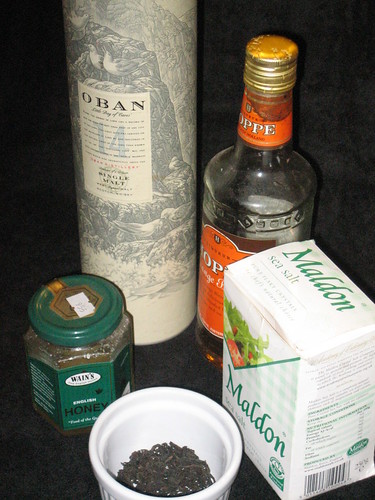
Ingredients, The Oban 14yr old, its quite easy to find as its one of "the six classic malts". I find it a gentle whisky that won't really offend or scare anyone. A medium lapsang (this is actually from a Dutch tea merchant :- Simon Levelt ,who als supplied the smoked Earl Grey for the Picard). Some local honey. Hoppe's orange bitters.Finally some good sea salt (I think this is Kosher salt for US readers).
Since I drink a fair amount of loose tea I have tea filters (DIY tea bags) around, that makes the infusion a bit easier. The colour of the Oban doesn't really change dramatically during the infusion, so keep an eye (and a taste on it, we don't want it to get bitter). The lapsang and the Oban go well together the earthy lapsang is up at the front, the whisky filling in the body behind, but still on the fierce side. How though would it be best to bring it together. My first thought was a Manhattan variation, since it's a versatile classic, but I was worried the vermouth would overpower the notes I wanted. Then it dawned on me, bitters, sugar & whisky, that is an old-fashioned.
Tea for two a modern twist on an old fashioned.
A couple of flakes of sea salt go in the bottom of your glass (I couldn't resist the glass tea cups, sorry). (as an aside, I'm quite sensitive to salt, you might want to up to maybe a half pinch) Put a half bar spoon of honey in & then add a couple of spoons of orange bitters, stir/muddle the salt & honey into the bitters, splash in some of the tea infused whisky & a couple-3 ice cubes. Stir/muddle till everything is dissolved. Add more whisky to the depth you or your drinkers enjoy, stir a bit more and then remove the ice cubes. Put a fresh ice cube into each glass, pare off a bit of orange zest and then squeeze (flame if you like or are trying to impress) to get the oils onto the surface of the drink, and drop into the glass as decoration.
Oban is a place I visited a few times and they make a fine malt, that sometimes gets called an island due to the saltiness of having you distillery on the sea front. The tasting notes for the Oban are smoke,honey,salt,orange in no particular order. This and a recent reading of Embury gave me an idea, could I boost the flavours & smooth out the alcohol ?
Ingredients, The Oban 14yr old, its quite easy to find as its one of "the six classic malts". I find it a gentle whisky that won't really offend or scare anyone. A medium lapsang (this is actually from a Dutch tea merchant :- Simon Levelt ,who als supplied the smoked Earl Grey for the Picard). Some local honey. Hoppe's orange bitters.Finally some good sea salt (I think this is Kosher salt for US readers).
Since I drink a fair amount of loose tea I have tea filters (DIY tea bags) around, that makes the infusion a bit easier. The colour of the Oban doesn't really change dramatically during the infusion, so keep an eye (and a taste on it, we don't want it to get bitter). The lapsang and the Oban go well together the earthy lapsang is up at the front, the whisky filling in the body behind, but still on the fierce side. How though would it be best to bring it together. My first thought was a Manhattan variation, since it's a versatile classic, but I was worried the vermouth would overpower the notes I wanted. Then it dawned on me, bitters, sugar & whisky, that is an old-fashioned.
Tea for two a modern twist on an old fashioned.
A couple of flakes of sea salt go in the bottom of your glass (I couldn't resist the glass tea cups, sorry). (as an aside, I'm quite sensitive to salt, you might want to up to maybe a half pinch) Put a half bar spoon of honey in & then add a couple of spoons of orange bitters, stir/muddle the salt & honey into the bitters, splash in some of the tea infused whisky & a couple-3 ice cubes. Stir/muddle till everything is dissolved. Add more whisky to the depth you or your drinkers enjoy, stir a bit more and then remove the ice cubes. Put a fresh ice cube into each glass, pare off a bit of orange zest and then squeeze (flame if you like or are trying to impress) to get the oils onto the surface of the drink, and drop into the glass as decoration.What you should get is a boosted Oban that is smoothed out and notched back from its usual fierceness.
Subscribe to:
Posts (Atom)